Overview of the Bahrain Stock Exchange (Bahrain Bourse)
A comprehensive overview of the Bahrain Stock Exchange (Bahrain Bourse), analyzing its market structure, regulation, liquidity characteristi...
Most people assume that stock prices move because of news. A headline appears, investors react, and prices change. This explanation is intuitive, simple, and largely wrong. News does not move prices by itself. Prices move because of how news interacts with expectations, positioning, liquidity, and existing narratives. The same piece of news can push a stock higher, lower, or nowhere at all, depending on context.
This misunderstanding causes many investors and traders to consistently misread market behavior. They expect prices to rise on “good news” and fall on “bad news,” only to watch the opposite happen. The problem is not the market. The problem is a flawed mental model of how information is processed.
For investors operating from GCC countries, this issue is magnified. Most exposure is to global equity markets, particularly U.S. markets, where news often breaks outside local business hours. By the time GCC-based investors see a headline, markets may have already absorbed, discounted, or reversed its impact. Understanding how news actually affects prices is therefore essential for avoiding reactive and poorly timed decisions.
This article explains how stock market news truly affects prices. It focuses strictly on equities and on GCC-based investors accessing global markets. The goal is to replace headline-driven thinking with a structural understanding of expectations, positioning, and price behavior.
The single most important principle in understanding market reactions is this: prices reflect expectations, not reality. Long before a news event occurs, markets attempt to anticipate its outcome.
Earnings reports, economic data, interest rate decisions, and geopolitical events are rarely surprises in absolute terms. Analysts publish forecasts, institutions position portfolios, and narratives form weeks or months in advance. By the time news is released, much of its impact is already embedded in price.
When news aligns with expectations, prices often barely move. When news deviates from expectations, prices react sharply—even if the news itself appears objectively positive or negative.
One of the most confusing market behaviors for new investors is seeing prices fall after positive news. This happens when expectations were even more optimistic than reality.
If a stock has been bid up aggressively ahead of an earnings release, strong results may still disappoint if they fail to exceed optimistic assumptions. In such cases, the news is “good,” but not good enough. Price adjusts downward to reflect revised expectations.
This phenomenon is often described as “buy the rumor, sell the news,” but the deeper mechanism is expectation reset.
Conversely, prices sometimes rise on bad news. This occurs when expectations were excessively pessimistic.
If investors anticipate severe damage and reality turns out to be merely bad rather than catastrophic, prices may rise as expectations improve. Relief rallies are common after feared outcomes fail to materialize.
This is why understanding sentiment and positioning matters more than judging headlines in isolation.
News interacts with positioning. If most investors are already long a stock, positive news has limited upside because buyers are already committed. Negative news, however, can trigger sharp sell-offs as crowded positions unwind.
If positioning is light or defensive, positive news can lead to strong rallies as investors rush to establish exposure. Negative news may have limited downside because pessimism is already priced in.
Price movement reflects who needs to act, not who is right.
Liquidity plays a critical role in how news affects prices. In highly liquid stocks with deep order books, news is absorbed more smoothly. In thinly traded stocks, small changes in demand can cause large price swings.
During periods of low liquidity—such as overnight sessions, holidays, or market stress—news can trigger exaggerated moves. For GCC-based investors, this is especially relevant because many major news events occur during U.S. trading hours or after-market sessions.
Understanding liquidity conditions helps explain why some news-driven moves appear disproportionate.
Markets do not treat all news the same. News that affects long-term cash flows, risk profiles, or discount rates tends to matter far more than transient headlines.
Earnings guidance, regulatory changes, interest rate policy, and structural shifts carry more weight than isolated incidents or commentary. Even dramatic-sounding news may have little lasting impact if it does not alter fundamentals.
Experienced investors learn to differentiate between information that changes valuation and information that merely changes mood.
The same news can have different effects depending on when it occurs. News released during strong trends often reinforces existing direction. News released during fragile or overextended conditions may trigger reversals.
This is why technical context and market structure matter. News does not operate in a vacuum. It interacts with momentum, support and resistance, and volatility regimes.
Ignoring timing leads to misinterpretation of cause and effect.
Markets are probability machines. Prices adjust based on perceived likelihoods of future outcomes.
News shifts probabilities, not absolutes. A regulatory decision may increase the probability of slower growth, but it rarely eliminates growth entirely. Prices move to reflect this probabilistic adjustment.
This explains why reactions are often measured rather than binary.
By the time news reaches the average investor, markets have often already reacted. Professional participants digest information quickly, adjust positions, and provide liquidity.
Reactive trading based on headlines typically results in late entries, poor risk-reward, and emotional decision-making. This is especially true for investors operating across time zones.
Understanding how news affects prices reduces the urge to react and improves strategic patience.
Long-term investors should treat news as information, not instruction. The key question is not “what happened,” but “does this change long-term cash flow, risk, or valuation?”
Most news does not meet this threshold. Noise is frequent; structural change is rare.
Disciplined investors use news to update assumptions, not to initiate impulsive action.
For traders, news provides catalysts, not direction. Direction is determined by structure and positioning.
Successful traders evaluate whether news aligns with or contradicts existing trends and whether it is likely to force repositioning.
This approach replaces emotional reaction with strategic assessment.
Investors in the GCC face inherent disadvantages in reacting to real-time news from global markets. Attempting to compete on speed is unrealistic.
Understanding how news actually affects prices levels the playing field. It shifts focus from reaction to preparation, from headlines to structure.
This understanding is a behavioral edge, not a technical one.
Stock market news does not operate as a direct trigger for price movement. It acts as an input into a much larger system built on expectations, positioning, liquidity, and probability. Prices move not because something happened, but because the market’s collective view of what is likely to happen next has changed. When news confirms existing expectations, prices often do very little. When it challenges those expectations, prices can move violently, even if the headline itself appears benign.
This distinction is critical for understanding why markets so often behave in ways that feel counterintuitive. Good news can mark the end of a rally, not its beginning. Bad news can signal relief rather than collapse. These reactions are not irrational; they are adjustments. Markets are constantly repricing based on who is already positioned, who must act, and how much liquidity is available when expectations shift.
For investors and traders operating from GCC countries, this understanding is more than academic. Global equity markets digest information rapidly, often during hours when local participants are unavailable. Attempting to react to breaking news from a distance almost guarantees poor timing and unfavorable risk-reward. Speed is not an edge in this environment. Context is. Knowing how news is likely to interact with positioning and market structure allows preparation rather than reaction.
Interpreting news correctly also reduces emotional decision-making. Headlines are designed to provoke urgency, fear, or excitement. Markets, however, reward those who remain detached and analytical. When news is viewed as a probability update rather than a command to act, investors are far less likely to chase prices, panic during volatility, or abandon well-constructed strategies.
Over the long term, successful participation in equity markets depends on understanding that news is rarely the cause of price movement and almost never a reliable signal on its own. It is one variable among many, and often not the most important one. For GCC-based investors seeking durable exposure to global stock markets, mastering this perspective transforms news from a source of confusion into a tool for refining expectations. Markets do not move on headlines. They move on how those headlines change the balance between belief, positioning, and risk.
Because expectations already reflected the information.
Usually not. By the time news is public, price adjustment is often underway.
Short-term reactions can overshoot, but they are usually corrected as positioning stabilizes.
It provides context for both, but rarely clear signals for either.
Disclaimer: This content is for education only and is not investment advice.

A comprehensive overview of the Bahrain Stock Exchange (Bahrain Bourse), analyzing its market structure, regulation, liquidity characteristi...

An in-depth analysis of the Kuwait Stock Exchange (Boursa Kuwait), explaining its structure, regulation, market behavior, and strategic rele...

A senior-level analysis explaining when stocks make more sense than diversified asset trading, focusing on correlation risk, time horizons, ...
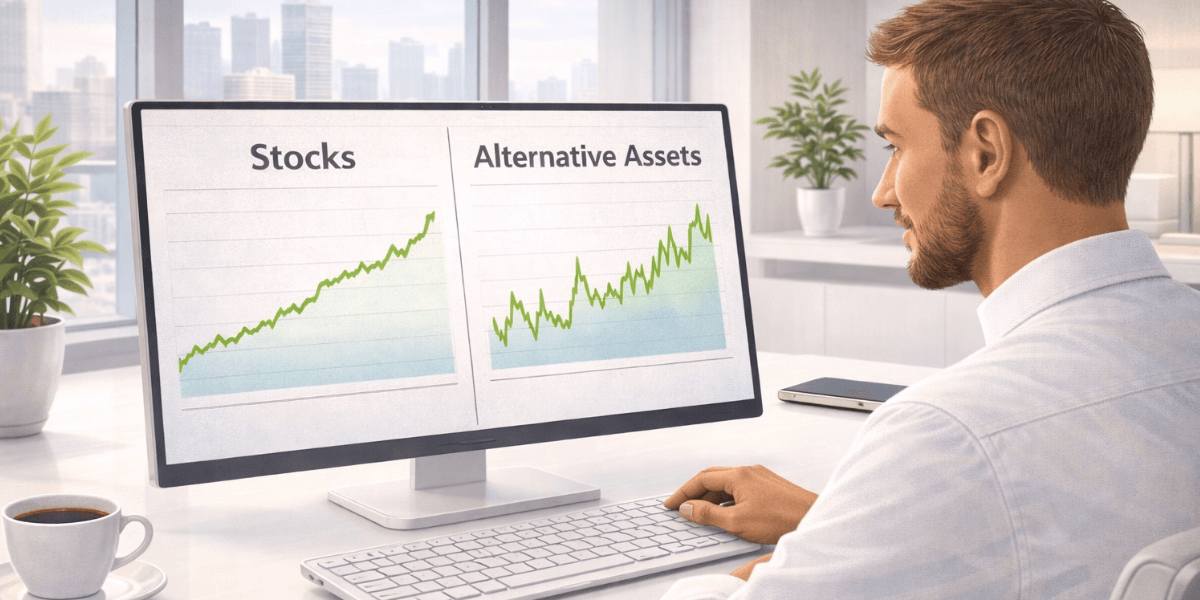
A senior-level analysis comparing stocks and alternative assets from a conservative investing perspective, explaining capital durability, tr...

A senior-level analysis explaining why stocks are fundamentally easier to analyze than other assets, focusing on cash flows, accounting stru...

A senior-level risk analysis comparing stocks and speculative assets, explaining how permanent capital risk, time horizons, and recovery dyn...