Overview of the Bahrain Stock Exchange (Bahrain Bourse)
A comprehensive overview of the Bahrain Stock Exchange (Bahrain Bourse), analyzing its market structure, regulation, liquidity characteristi...
Starting to invest in stocks is usually presented as a technical milestone: open an account, fund it, buy shares, and monitor results. This framing is appealing because it offers clarity and action. It is also deeply misleading. Long-term stock investing does not fail because people do not know how to place orders. It fails because investors enter the market with mental models that are incompatible with how markets actually work over time.
A long-term mindset is not a personality trait, nor is it synonymous with patience. It is a structural approach to uncertainty. It determines how an investor interprets volatility, how they react to drawdowns, and how they define progress. Without this framework, even well-constructed portfolios become fragile, because every price movement is interpreted as a signal requiring response.
Markets do not reward activity. They reward alignment. Stocks represent long-duration claims on uncertain future cash flows generated by competitive businesses operating in dynamic economies. This reality immediately clashes with the expectations most new investors bring with them: fast validation, linear progress, and controllable outcomes. When those expectations collide with market behavior, frustration follows, and frustration leads to destructive decisions.
For investors in the GCC, the cost of this mismatch is often higher. Equity investing is frequently used as a long-term growth engine alongside concentrated local assets, family businesses, or real estate exposure. Portfolios are expected to preserve purchasing power in USD-pegged currencies, compound over decades, and remain resilient across economic cycles. Approaching this role with a short-term mindset turns stocks into a source of instability rather than a stabilizing force.
This article explains how to start investing in stocks with a genuinely long-term mindset. Not through checklists or tactics, but by building a mental and structural framework that survives time, volatility, and uncertainty. The objective is not to outperform next year, but to remain aligned with how capital actually compounds over a lifetime.
The foundation of long-term investing is not confidence, but acceptance. Markets are uncertain by nature. Prices reflect incomplete information, competing expectations, liquidity constraints, and constant adaptation. There is no stable state where uncertainty disappears. Long-term investors accept this reality and design around it.
Short-term mindsets treat uncertainty as a temporary obstacle. Investors search for clarity through analysis, signals, or narratives, believing that sufficient effort will reduce ambiguity. Long-term investors understand that ambiguity is structural. The goal is not to eliminate it, but to remain functional within it.
This acceptance fundamentally alters behavior. Volatility loses its interpretive authority. Price movements are no longer treated as instructions. They become background noise around a process that unfolds over years and decades. This does not make losses pleasant, but it makes them expected.
For new investors, this shift is uncomfortable because it removes the illusion of control. Long-term investing requires giving up the belief that every outcome can be managed. What replaces control is resilience.
Accepting uncertainty is not passive resignation. It is the prerequisite for designing durable investment structures.
A stock is not a ticker symbol. It is a fractional ownership claim on a business operating within an economy. This distinction is critical for long-term investing, yet it is often ignored in practice.
Businesses generate value through production, innovation, and capital allocation. These processes unfold slowly and unevenly. Market prices, by contrast, fluctuate continuously in response to sentiment, liquidity, and macro narratives. Confusing price behavior with business progress is one of the most common sources of long-term error.
Long-term investors anchor their expectations to economic reality rather than market noise. They understand that temporary mispricing is not only inevitable, but necessary for markets to function. Volatility becomes a feature of participation, not a flaw.
For GCC investors allocating to global equities, this perspective is particularly important. International stock exposure is not about trading foreign markets. It is about participating in global business growth denominated in stable currencies over long horizons.
Seeing stocks as economic claims shifts focus from reaction to alignment.
Most investors treat time as something to endure. Long-term investors treat time as an active asset. Over extended horizons, compounding overwhelms randomness. Short-term outcomes are noisy; long-term outcomes reflect structure.
Time allows businesses to reinvest profits, adapt to competition, and benefit from economic expansion. It also allows markets to correct misallocations and absorb shocks. The longer capital remains invested, the less important individual entry points become.
This is why participation matters more than precision. Many of the market’s most important gains occur during recoveries, often when sentiment remains negative. Investors who attempt to optimize timing risk being absent during these periods.
Long-term investors design portfolios to remain invested through cycles. They accept temporary underperformance as the cost of exposure to long-term growth. This acceptance reduces the impulse to intervene at precisely the wrong moments.
Time does not eliminate risk, but it transforms its nature.
Long-term investing rarely fails because of a single bad decision. It fails because of structural fragility. Overconcentration, excessive trading, leverage, and emotional reactions introduce failure points that compound over time.
These mistakes are typically driven by impatience. When investors expect rapid results, they design strategies that cannot survive normal market behavior. Drawdowns are interpreted as errors rather than as expected features of participation.
A long-term mindset redefines success. Success is not measured by short-term outperformance, but by the ability to remain aligned with a sound structure across decades. This reframing dramatically reduces destructive behavior.
Instead of constantly optimizing, long-term investors prioritize robustness. They accept that no strategy performs best at all times, and that endurance matters more than brilliance.
Durability, not cleverness, is the primary objective.
Diversification is not an optional enhancement to long-term investing. It is a requirement. Markets concentrate returns in a small subset of companies, and identifying these winners in advance is extremely difficult.
Diversification ensures participation without prediction. By holding a broad set of assets, investors capture the aggregate outcome of economic growth while reducing dependence on specific successes.
Beyond risk management, diversification has behavioral benefits. When outcomes are not dominated by a few positions, volatility becomes easier to tolerate. This psychological stability supports discipline.
For GCC investors, diversification often means balancing regional exposure with global equities. This reduces dependence on local cycles and sector concentration.
Diversification creates the conditions under which patience becomes viable.
Markets punish impatience more consistently than ignorance. Fear during downturns and greed during rallies drive many investors to abandon sound strategies at the worst possible times.
A long-term mindset anticipates these pressures and designs constraints around them. Clear objectives, infrequent portfolio changes, and predefined allocation ranges reduce the need for discretionary decisions.
This discipline is not a matter of willpower. It is structural. Investors who rely on emotional control eventually fail. Investors who design systems that limit bad decisions endure.
Long-term investing succeeds not because investors are calm, but because their structure does not require them to be.
Starting to invest in stocks with a long-term mindset is not about delaying gratification; it is about redefining what progress means. Long-term investing works because it aligns behavior with how markets actually generate returns, not with how investors wish they would behave.
A long-term mindset accepts uncertainty as permanent, time as an ally, and volatility as the cost of participation. It replaces prediction with structure, reaction with resilience, and activity with alignment. These shifts may appear subtle, but over decades they determine whether capital compounds or erodes.
For investors in the GCC, this mindset is particularly valuable. Equity investing is often used to complement concentrated assets, preserve purchasing power in USD-pegged currencies, and support multi-decade wealth objectives. These goals cannot be achieved through short-term thinking. They require endurance.
Markets will test patience repeatedly. Drawdowns will occur. Narratives will change. A long-term mindset does not prevent these challenges, but it ensures they do not dictate behavior. Instead of reacting to noise, the investor remains anchored to structure.
In investing, survival precedes success. Compounding requires time, and time requires durability. A long-term mindset is how durability is built.
No. It means decisions are driven by structure and objectives, not short-term emotions.
Yes. Volatility is expected and absorbed over long horizons.
Typically measured in decades rather than years.
Because it aligns with capital preservation, USD-pegged currencies, and multi-generational wealth planning.
Disclaimer: This content is for education only and is not investment advice.

A comprehensive overview of the Bahrain Stock Exchange (Bahrain Bourse), analyzing its market structure, regulation, liquidity characteristi...

An in-depth analysis of the Kuwait Stock Exchange (Boursa Kuwait), explaining its structure, regulation, market behavior, and strategic rele...
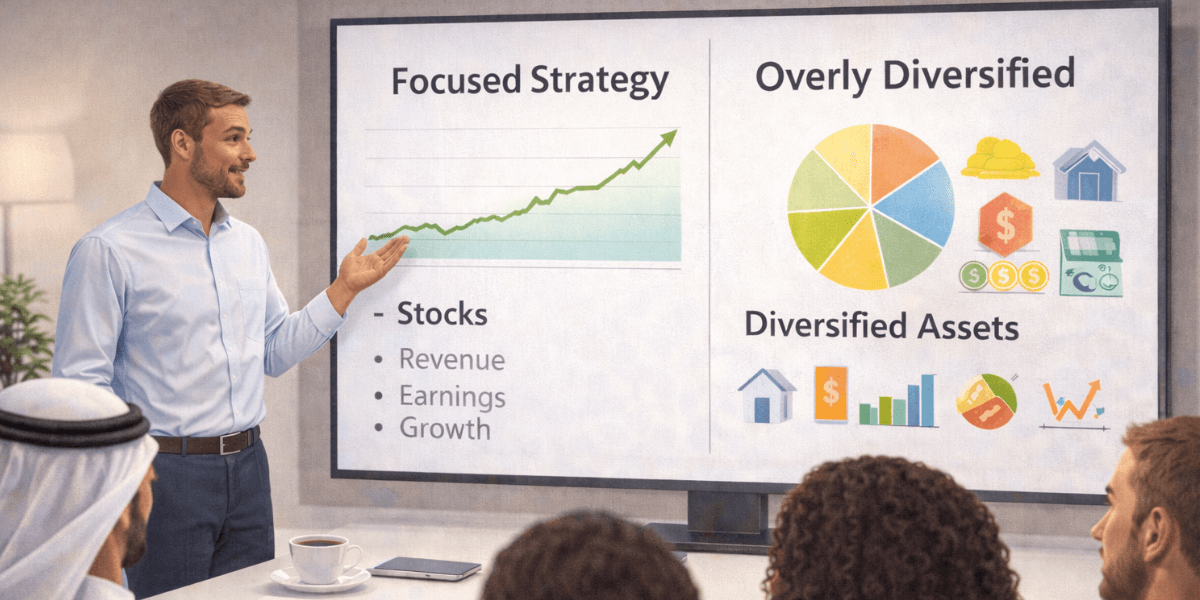
A senior-level analysis explaining when stocks make more sense than diversified asset trading, focusing on correlation risk, time horizons, ...
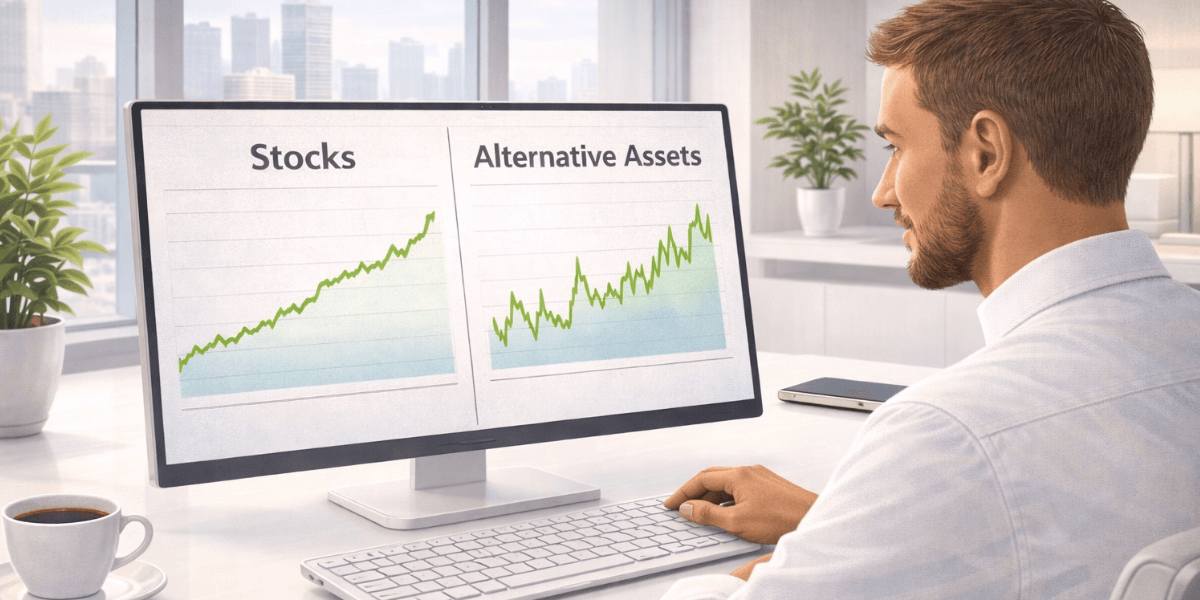
A senior-level analysis comparing stocks and alternative assets from a conservative investing perspective, explaining capital durability, tr...

A senior-level analysis explaining why stocks are fundamentally easier to analyze than other assets, focusing on cash flows, accounting stru...

A senior-level risk analysis comparing stocks and speculative assets, explaining how permanent capital risk, time horizons, and recovery dyn...