Overview of the Bahrain Stock Exchange (Bahrain Bourse)
A comprehensive overview of the Bahrain Stock Exchange (Bahrain Bourse), analyzing its market structure, regulation, liquidity characteristi...
Range trading is one of the most mischaracterized approaches in stock market education. It is often presented as a simple idea: buy near support, sell near resistance, repeat. This description is not only incomplete; it is dangerous. It frames range trading as a visual pattern exercise rather than what it actually is: a strategy built on market structure, liquidity recycling, and behavioral equilibrium.
In real markets, ranges do not exist because prices are indecisive or “bored.” They exist because opposing forces reach a temporary balance. Buyers are willing to accumulate only up to a certain price, and sellers are willing to distribute only down to a certain level. Between those boundaries, liquidity circulates. Outside them, the balance breaks.
For investors and traders in the GCC, range trading deserves special attention—not because it is easy, but because many markets relevant to the region spend extended periods in range-bound behavior. This includes not only regional exchanges such as Saudi Arabia, the UAE, and Qatar, but also U.S. equities traded by GCC-based investors during overlapping global sessions. Understanding why ranges form and how they persist is critical to operating professionally rather than reactively.
Most failed range traders do not fail because they misdraw lines. They fail because they misunderstand the conditions that allow a range to exist in the first place. They assume the range is permanent. They underestimate the probability of regime change. And they treat breakouts as “fake” until the loss forces them to accept reality.
This article approaches range trading from a structural perspective. It explains why ranges form, how liquidity and behavior sustain them, what makes them tradable, and what causes them to fail. It also explains why range trading can be deceptively risky and how GCC-based investors should adapt the concept to different market environments, time zones, and liquidity profiles.
Stock prices enter ranges when the market reaches a temporary equilibrium between supply and demand. This equilibrium is not philosophical; it is transactional. At certain price levels, enough participants are willing to buy to absorb selling pressure. At higher levels, enough participants are willing to sell to absorb buying pressure. The result is a bounded zone where price oscillates.
This equilibrium often emerges after a directional move exhausts itself. A rally may stall when early buyers take profits and new buyers demand better prices. A decline may stabilize when sellers become scarce and longer-term investors begin accumulating. The market does not reverse immediately; instead, it digests.
Institutional behavior plays a central role. Large participants do not enter or exit positions in a single transaction. They scale in and out. This scaling creates repeated interaction at similar price levels, reinforcing boundaries. Over time, these boundaries become visible not because traders draw them, but because repeated transactions occur there.
Liquidity providers further stabilize ranges. In calm conditions, market makers and systematic strategies profit by providing liquidity near perceived value. They buy when price dips into the lower boundary and sell when it approaches the upper boundary. Their activity dampens volatility and encourages mean oscillation.
In GCC-related markets, range formation can be especially pronounced during periods of macro stability, when oil prices are stable, monetary policy expectations are clear, and earnings outlooks are not being repriced aggressively. In these conditions, capital tends to rotate rather than trend, reinforcing range behavior.
At its core, range trading is about liquidity, not geometry. Support and resistance are not magical lines; they are zones where liquidity concentrates. Traders who treat them as exact levels misunderstand their function.
Liquidity accumulates near boundaries because participants place limit orders there. Buyers wait near the lower boundary to avoid paying up. Sellers wait near the upper boundary to maximize exit prices. As long as these behaviors persist, price oscillates.
Successful range trading requires understanding that liquidity is dynamic. The lower boundary is not a single price. It is an area where buying interest outweighs selling pressure—until it doesn’t. The same applies to the upper boundary.
This distinction matters because it changes execution behavior. Entering too early inside the range exposes the trader to unnecessary noise. Entering too late near the boundary exposes the trader to breakout risk. Professional range traders operate with patience and accept missed trades as a cost of discipline.
For GCC-based investors trading U.S. stocks, liquidity dynamics are further influenced by session timing. The overlap between European, Middle Eastern, and U.S. sessions can change how ranges behave intraday. A range that holds during Asian and European hours may break decisively during the U.S. open when institutional flow enters.
Human behavior reinforces ranges. Market participants anchor to recent prices. If a stock has traded between two levels for weeks, those levels become reference points. Traders expect reversals because they have seen them before.
This expectation creates self-reinforcing behavior. Traders fade moves near boundaries. Stops cluster just beyond them. Liquidity thickens inside the range and thins outside it. As long as no new information disrupts this behavior, the range persists.
Range environments also reduce urgency. Without a clear trend, fear of missing out diminishes. Participants become more selective. This selectivity reduces momentum and reinforces oscillation.
However, this same behavioral conditioning becomes a vulnerability. When the range finally breaks, many participants are positioned incorrectly. Stops cascade. Liquidity vanishes. What looked stable becomes unstable quickly.
Understanding this transition—from comfort to urgency—is essential. Range trading is profitable when behavior is repetitive. It becomes dangerous when behavior shifts suddenly.
Range trading appears low risk because trades often resolve quickly. Small profits accumulate. Drawdowns feel manageable. This perception masks the true risk profile.
Range strategies typically have positive skew during stable periods and sharp losses during breakouts. The risk is not frequent losses; it is infrequent but decisive failures.
When a range breaks, price often moves fast because liquidity outside the range is thin. Stops trigger simultaneously. Slippage increases. Exits occur worse than expected.
This means risk management must be designed for the breakout, not the oscillation. Position sizing must assume that the worst loss will occur when conditions change, not when the range behaves as expected.
For GCC investors trading across regions, this risk is amplified by time zones. A range can break during hours when the trader is inactive, turning a controlled risk into an uncontrolled gap.
Range trading and trend trading are not competing techniques; they are regime-specific responses. Range trading assumes equilibrium. Trend trading assumes disequilibrium.
The mistake is not choosing one. The mistake is applying one in the wrong regime.
Markets transition between these states. A range is often a pause between trends. The longer the pause, the more violent the eventual move can be.
Professional traders spend more effort identifying regime than optimizing entries. If the environment supports balance, range logic applies. If the environment supports expansion, range logic becomes liability.
In GCC markets, regime shifts can occur around policy announcements, index inclusion changes, or macro developments tied to energy and global liquidity. Range traders must remain alert to these catalysts.
GCC markets have unique characteristics that influence range behavior. Sector concentration, foreign ownership limits, and regional investor composition can all affect how ranges form and break.
Local markets may experience extended ranges due to limited catalysts and stable macro conditions. At the same time, they may experience abrupt repricing when foreign flow enters or exits around index events.
For GCC-based investors trading international markets, the interaction between local and global narratives adds complexity. A U.S. stock may be range-bound technically while being sensitive to global macro data released outside GCC trading hours.
This reinforces the need for structural awareness. Range trading cannot be isolated from macro context, liquidity cycles, and session dynamics.
Adapting range concepts to GCC realities means prioritizing risk containment over frequency and accepting that not all ranges are tradable.
Range trading strategies in stocks are not simplistic support-and-resistance games. They are structural responses to equilibrium, liquidity recycling, and behavioral conditioning. When markets are stable, capital rotates rather than trends, and participants anchor to familiar levels, ranges can persist and be exploited with discipline.
The danger lies in mistaking persistence for permanence. Ranges exist only as long as the forces sustaining them remain intact. When those forces weaken—through new information, policy shifts, institutional flow, or macro regime change—the range does not gradually dissolve. It breaks.
For GCC investors, this reality is especially important. Regional markets and global equities accessed from the GCC operate across different liquidity regimes and time zones. A range that appears stable in one session can fail decisively in another. This makes risk management and position sizing more important than entry precision.
Professional range trading is therefore conservative in appearance but demanding in execution. It requires patience, acceptance of missed trades, respect for regime shifts, and a willingness to step aside when conditions change. It rewards structure, not stubbornness.
Ultimately, range trading is not about predicting reversals. It is about participating in balance while being prepared for imbalance. Those who understand this treat ranges as temporary opportunities. Those who do not treat them as promises—and markets are unforgiving toward promises that have expired.
They are better suited to tactical allocation and disciplined rebalancing rather than frequent short-term trading.
Because ranges break when underlying equilibrium shifts, causing liquidity to vanish and price to move rapidly.
They tend to work better in liquid, stable environments and worse during macro or policy-driven transitions.
By sizing positions conservatively, respecting session risk, and assuming that breakouts can occur when least convenient.
Disclaimer: This content is for education only and is not investment advice.

A comprehensive overview of the Bahrain Stock Exchange (Bahrain Bourse), analyzing its market structure, regulation, liquidity characteristi...

An in-depth analysis of the Kuwait Stock Exchange (Boursa Kuwait), explaining its structure, regulation, market behavior, and strategic rele...

A senior-level analysis explaining when stocks make more sense than diversified asset trading, focusing on correlation risk, time horizons, ...
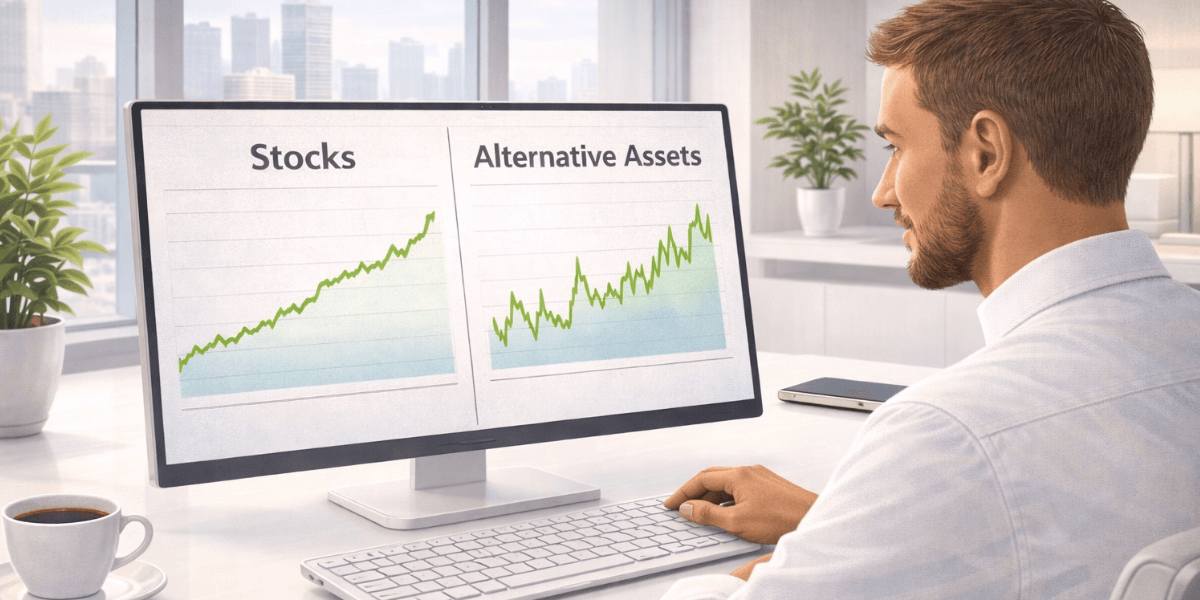
A senior-level analysis comparing stocks and alternative assets from a conservative investing perspective, explaining capital durability, tr...

A senior-level analysis explaining why stocks are fundamentally easier to analyze than other assets, focusing on cash flows, accounting stru...

A senior-level risk analysis comparing stocks and speculative assets, explaining how permanent capital risk, time horizons, and recovery dyn...