Overview of the Bahrain Stock Exchange (Bahrain Bourse)
A comprehensive overview of the Bahrain Stock Exchange (Bahrain Bourse), analyzing its market structure, regulation, liquidity characteristi...
Stocks and forex are frequently placed side by side as if they were two variations of the same activity. Both involve charts, prices, and the possibility of profit or loss, which creates the illusion that choosing between them is simply a matter of preference or strategy. In reality, stocks and forex are structurally different markets designed for different purposes, different participants, and different time horizons. Confusing these differences leads many investors to adopt expectations and behaviors that are incompatible with their long-term financial goals.
This confusion is especially visible among investors in GCC countries. The region has become a major target for forex marketing, with brokers promoting accessibility, high leverage, and the idea that trading currencies is a fast and efficient path to financial independence. At the same time, the economic reality for long-term wealth creation in the GCC increasingly depends on global equity exposure, particularly to U.S. companies that dominate innovation, technology, and global consumption. Understanding the structural difference between owning productive assets and speculating on price relationships is therefore essential.
Stocks represent ownership. When an investor buys shares of a company, they acquire a claim on a business that produces goods or services, generates cash flow, reinvests capital, and evolves over time. This ownership creates a natural mechanism for compounding wealth through earnings growth, reinvestment, dividends, and expansion. Over long periods, equity returns are driven not by prediction skill alone, but by the underlying growth of the global economy.
Forex trading, by contrast, is built around relative price movements between currencies. It does not involve ownership of a productive asset, nor does it benefit from a built-in growth engine. Currency values fluctuate based on interest rate differentials, monetary policy, geopolitical events, and capital flows. While long-term trends can exist, they are not designed to compound in the way corporate earnings do. The forex market is highly efficient, dominated by institutional players, and structurally oriented toward short-term trading rather than long-term holding.
For GCC-based investors, this distinction matters beyond theory. Many investors in the region have long-term objectives: preserving purchasing power, growing capital across generations, and building diversified global portfolios. These objectives align naturally with assets that compound over time and require patience rather than constant intervention. Markets that demand continuous monitoring, high leverage, and frequent decision-making introduce behavioral and operational risks that are difficult to sustain alongside professional and personal responsibilities.
This article explains the key differences between stocks and forex from a structural perspective. Rather than focusing on surface-level features such as spreads or trading hours, it examines what each market is designed to do, how value is created, how risk behaves over time, and which market aligns more naturally with long-term investing goals. For investors in the GCC accessing global markets, understanding these differences is not about choosing the “better” market in the abstract, but about choosing the market that fits the role of long-term wealth building.
The most fundamental difference between stocks and forex lies in ownership. When you buy a stock, you are purchasing an ownership stake in a real operating company. That company generates revenue, incurs costs, reinvests capital, and aims to grow over time. As a shareholder, you are entitled to a portion of the company’s economic output, whether through dividends, reinvested earnings, or long-term appreciation.
Forex trading, by contrast, does not involve ownership of a productive asset. When trading currency pairs, you are speculating on relative price movements between two currencies. There is no underlying business generating cash flow for you as a participant. Any profit comes from predicting short-term imbalances in supply and demand or macroeconomic shifts.
For GCC investors thinking in decades rather than days, this distinction matters. Ownership enables compounding through business growth. Price speculation does not.
Stock market returns are driven by value creation. Companies grow by increasing revenues, improving margins, expanding into new markets, and innovating. Over long periods, stock prices tend to follow earnings growth, adjusted for valuation cycles.
Forex markets, on the other hand, are largely zero-sum over time. Currency appreciation for one side of a pair implies depreciation for the other. There is no aggregate growth mechanism comparable to corporate earnings expansion. Long-term trends exist, but they are often cyclical and mean-reverting rather than compounding.
For long-term investors in the GCC, this difference explains why equities have historically outperformed currencies as a wealth-building vehicle. Stocks participate in global economic growth; forex reflects relative monetary conditions.
Stocks are naturally suited to longer time horizons. While short-term volatility can be significant, long-term returns are anchored to business fundamentals. Time works in favor of patient equity investors because earnings compound and businesses adapt.
Forex markets are structurally short-term. They respond rapidly to interest rate differentials, central bank policy, geopolitical events, and capital flows. Holding positions for extended periods often exposes traders to rollover costs and regime shifts that erode predictability.
For GCC investors with careers, businesses, or family responsibilities, markets that reward patience are structurally more compatible than those requiring constant monitoring.
Risk in stocks is primarily linked to business performance and valuation cycles. While stock prices fluctuate, the underlying asset continues to exist and operate. Long-term risk can be mitigated through diversification and time.
Forex trading is heavily dependent on leverage. Small price movements are amplified through borrowed capital, increasing both potential gains and losses. This leverage creates a fragile risk structure where minor adverse moves can wipe out capital quickly.
In the GCC, where forex brokers aggressively promote high leverage, many participants underestimate how structurally unstable leveraged currency trading is compared to owning unleveraged equities.
Stock investing involves relatively transparent costs: commissions, custody, and sometimes currency conversion. These costs are generally stable and predictable.
Forex trading embeds costs through spreads, swaps, financing charges, and execution friction. Over time, these costs accumulate, particularly for traders who hold positions overnight or trade frequently.
For long-term investors, sustainability matters more than tactical efficiency. Stock investing aligns better with low turnover and cost containment.
Stock markets allow investors to rely on publicly available financial statements, earnings reports, and long-term trends. While analysis requires effort, the information landscape is relatively transparent.
Forex markets are dominated by institutional players, central banks, and macro-driven flows. Retail traders often operate at an informational disadvantage, reacting to events rather than anticipating them.
For GCC investors without institutional resources, competing in equity markets over long horizons is structurally more feasible than consistently outperforming in forex.
Forex trading demands constant attention, rapid decision-making, and emotional discipline under high leverage. This environment amplifies behavioral errors such as overtrading, revenge trading, and risk escalation.
Stock investing, when approached long-term, reduces psychological strain by shifting focus from short-term price movements to business performance and portfolio construction.
For investors balancing investing with professional and personal commitments, the psychological sustainability of equities is a significant advantage.
Stocks are structurally aligned with long-term wealth creation because they combine ownership, compounding, scalability, and transparency. They allow investors to benefit from global economic growth without requiring constant intervention.
Forex trading can generate profits for skilled professionals, but it is not designed as a long-term investment vehicle. Its zero-sum nature, leverage dependence, and short-term focus make it incompatible with most long-term financial goals.
For GCC investors seeking to build sustainable wealth rather than chase short-term outcomes, equities provide a clearer and more robust path.
Stocks and forex are often discussed as if they were alternative routes to the same destination, but they are not designed to achieve the same outcomes. Forex is a speculative market built around short-term price relationships between currencies, driven by macroeconomic forces and institutional flows. Stocks are ownership claims on productive businesses that grow, adapt, and reinvest over time. This structural difference determines how each market behaves, how risk manifests, and how wealth is created—or not created—over long horizons.
For long-term investors, the presence or absence of a compounding mechanism is decisive. Stocks benefit from earnings growth, reinvestment, and global economic expansion. Even when markets experience volatility, the underlying businesses continue to operate, innovate, and generate value. Over decades, this process has historically translated into real wealth growth for patient investors. Forex markets, by contrast, do not compound. Gains in one currency are offset by losses in another, and long-term returns depend almost entirely on timing, leverage, and tactical skill.
In the GCC context, this distinction carries particular weight. Many investors in the region are not seeking constant engagement with markets. They are building portfolios alongside careers, businesses, and family responsibilities. Markets that require continuous attention, rapid reaction to news, and tolerance for high leverage introduce psychological and operational burdens that are difficult to sustain over long periods. The cost of mistakes in leveraged forex trading is immediate and often irreversible, while the cost of short-term volatility in equities is usually temporary for long-term holders.
This does not mean that forex has no legitimate role. Currency markets are essential to global finance, and skilled professionals can and do generate profits through disciplined trading. However, this activity resembles a specialized profession more than an investment vehicle. Treating forex as a long-term wealth-building strategy for the average investor is a structural mismatch, not a failure of discipline or education.
Stocks, while imperfect and volatile, are structurally aligned with long-term objectives. They allow investors to participate in global growth without needing to predict short-term price movements. They reward patience rather than constant action. For GCC-based investors with access to international markets, equities provide exposure to industries, technologies, and economic forces that cannot be replicated locally or through currency speculation.
Ultimately, choosing between stocks and forex is a choice between ownership and speculation, between compounding and trading, and between building wealth gradually or attempting to extract it tactically. For investors whose primary goal is long-term capital growth and financial resilience, the structural advantages of stocks make them the more suitable foundation. Forex may offer opportunity for a small, specialized segment of participants, but equities remain the market best aligned with long-term investing from the GCC.
Forex markets are not designed for long-term investing. They lack a natural compounding mechanism and are heavily influenced by short-term macro factors.
Stocks carry market risk, but their risk structure is more stable over long horizons compared to leveraged forex trading.
Accessibility, aggressive marketing, and high leverage offerings have made forex widely visible, even though it is not suitable for most long-term investors.
They can, but they serve very different purposes. Stocks are typically the core long-term asset, while forex is speculative and tactical.
Disclaimer: This content is for education only and is not investment advice.

A comprehensive overview of the Bahrain Stock Exchange (Bahrain Bourse), analyzing its market structure, regulation, liquidity characteristi...

An in-depth analysis of the Kuwait Stock Exchange (Boursa Kuwait), explaining its structure, regulation, market behavior, and strategic rele...
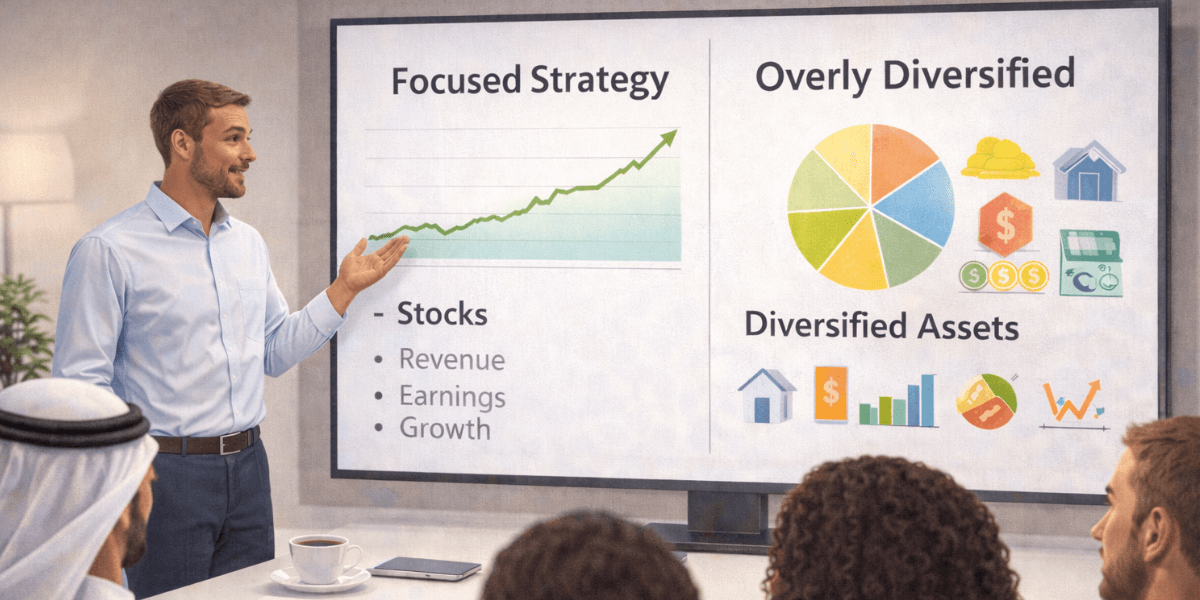
A senior-level analysis explaining when stocks make more sense than diversified asset trading, focusing on correlation risk, time horizons, ...
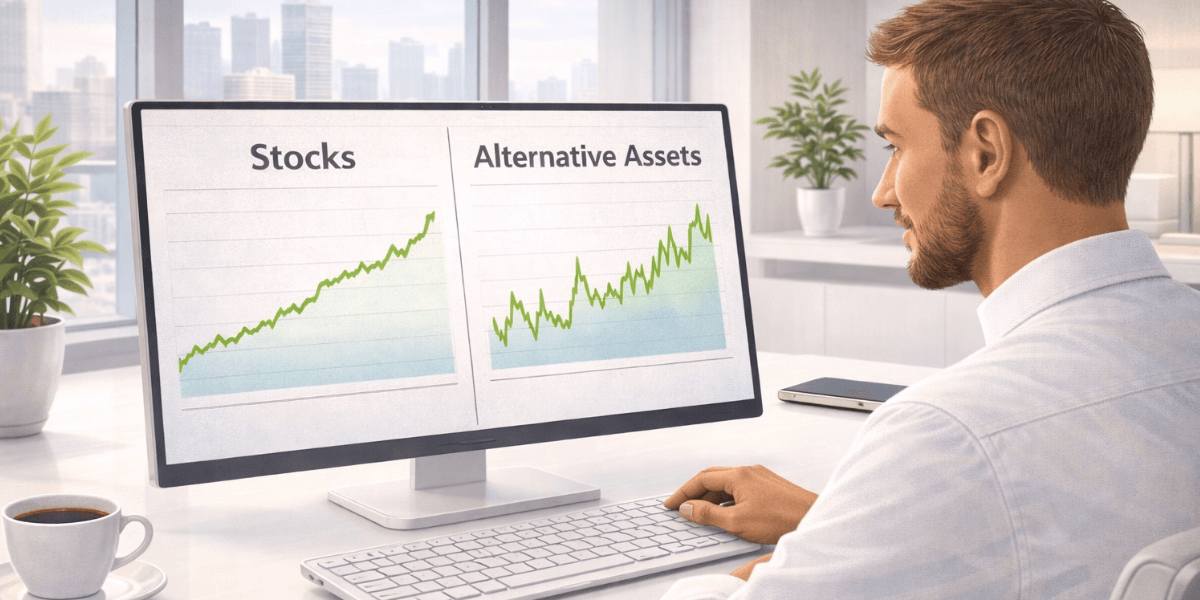
A senior-level analysis comparing stocks and alternative assets from a conservative investing perspective, explaining capital durability, tr...
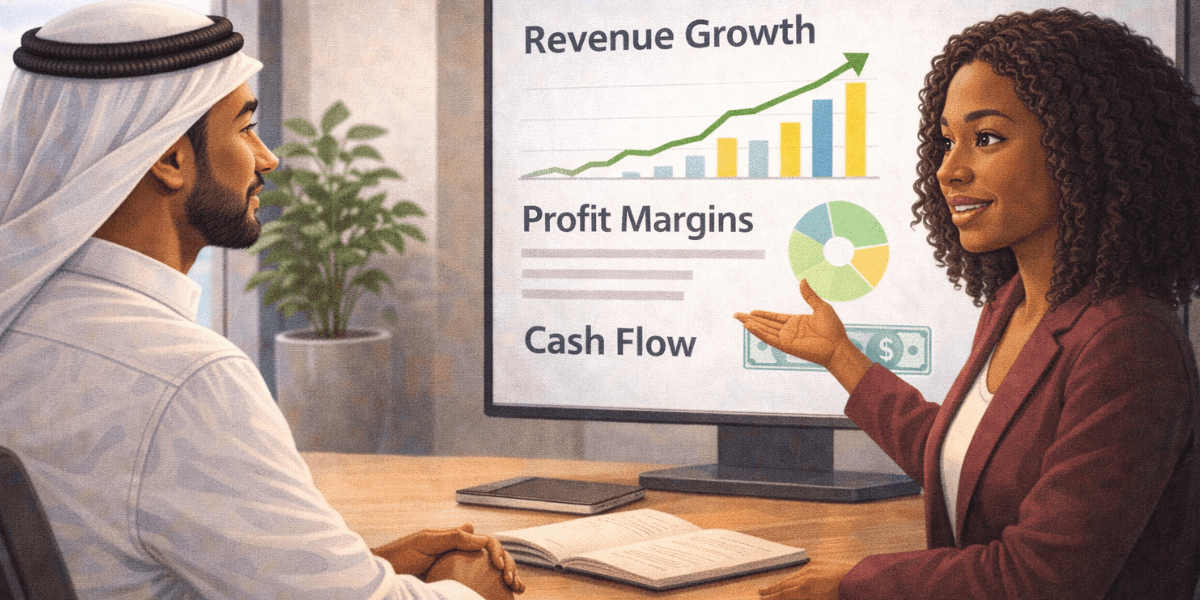
A senior-level analysis explaining why stocks are fundamentally easier to analyze than other assets, focusing on cash flows, accounting stru...
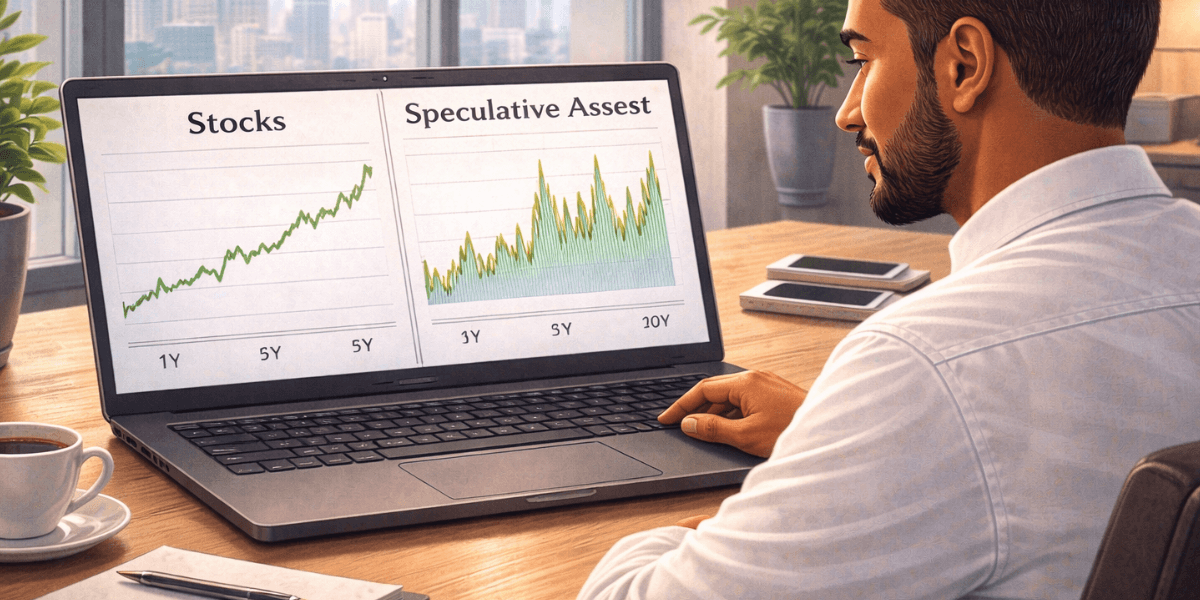
A senior-level risk analysis comparing stocks and speculative assets, explaining how permanent capital risk, time horizons, and recovery dyn...