Overview of the Bahrain Stock Exchange (Bahrain Bourse)
A comprehensive overview of the Bahrain Stock Exchange (Bahrain Bourse), analyzing its market structure, regulation, liquidity characteristi...
Few investment comparisons are as emotionally charged—and as misunderstood—as stocks versus gold. One represents progress, productivity, and economic expansion. The other represents permanence, scarcity, and protection against systemic failure. Investors often frame the choice as ideological rather than functional, asking which asset is “better” instead of asking what each asset is designed to do. That framing error is responsible for years of poor allocation decisions.
Stocks and gold are not competitors operating in the same lane. They solve different problems. Stocks are growth assets: they are built to generate wealth over time through earnings, reinvestment, and compounding. Gold is a preservation asset: it is designed to maintain purchasing power across long periods, especially during monetary instability, inflation shocks, or loss of confidence in financial systems. Expecting gold to behave like stocks—or stocks to behave like gold—is a category mistake.
This distinction matters most for long-term investors. When portfolios are built without understanding the structural role of each asset, investors panic during drawdowns, overreact to macro headlines, and rotate capital at precisely the wrong moments. Gold rallies are mistaken for growth signals. Stock corrections are mistaken for systemic collapse. The result is emotional allocation instead of strategic allocation.
Understanding stocks versus gold through the lens of growth versus preservation restores clarity. It explains why stocks dominate long-term wealth creation despite volatility, and why gold remains relevant even though it does not compound. It also explains why holding too much of either asset can quietly sabotage portfolio objectives. This article breaks down how stocks and gold behave differently across time horizons, inflation regimes, crises, and psychological stress—and how to assign each a rational role without turning investing into a belief system.
When you buy stocks, you acquire ownership in businesses. Those businesses employ labor, deploy capital, innovate, compete, and adapt. Their value is not static; it evolves with productivity, technology, and demand. Over time, successful companies increase revenues, expand margins, and reinvest profits. This process creates growth.
Gold, by contrast, is not productive. It does not generate cash flows, dividends, or earnings. An ounce of gold today is fundamentally the same as an ounce of gold a century ago. Its value is derived from scarcity, durability, and collective belief in its role as a store of value. Gold does not grow; it endures.
This single distinction explains most behavioral differences. Stocks participate in economic expansion. Gold stands outside the productive economy, acting as a monetary reference rather than an economic engine.
Stocks benefit from compounding. Earnings build upon earnings. Dividends are reinvested. Buybacks reduce share counts. Even modest annual growth rates accumulate into substantial wealth over decades. This creates an upward bias in long-term stock returns despite frequent setbacks.
Gold has no compounding mechanism. Its long-term return depends entirely on changes in purchasing power, currency debasement, and investor demand during periods of stress. Over very long horizons, gold has tended to preserve real value rather than multiply it.
This is why stocks dominate wealth creation charts over 20–40 year periods, while gold’s strongest performance often occurs in shorter, crisis-driven windows.
During periods of economic growth and stability, stocks typically outperform gold by a wide margin. Businesses benefit from rising consumption, expanding credit, and improving efficiency. Investors are rewarded for taking productive risk.
Gold tends to stagnate or underperform in these environments. When confidence in growth and financial systems is high, the demand for defensive stores of value diminishes. Gold does not collapse, but it often drifts sideways for extended periods.
This divergence highlights the opportunity cost of holding excessive gold during long expansions: capital is preserved, but growth is sacrificed.
Gold shines during periods of systemic stress. Financial crises, banking instability, currency devaluation, and geopolitical shocks often trigger demand for assets perceived as independent of the financial system. In these moments, gold functions as psychological insurance.
Stocks, meanwhile, can experience sharp drawdowns during crises as earnings expectations collapse and risk premiums expand. Even fundamentally strong companies may suffer temporarily as liquidity dries up and fear dominates decision-making.
However, this divergence is time-bound. Crises eventually pass. Economies adapt. Businesses recover. Stocks resume growth. Gold often retreats once stability returns, having served its role as a temporary refuge.
Gold is commonly viewed as an inflation hedge, and historically it has performed well during periods of high or unexpected inflation—particularly when inflation is driven by monetary instability or loss of confidence in fiat currencies.
Stocks respond to inflation in a more nuanced way. Companies with pricing power can pass higher costs to consumers, preserving real earnings. Others suffer margin compression. This creates dispersion, not uniform destruction.
In moderate, growth-linked inflation environments, stocks often outperform gold. In extreme or disorderly inflation, gold tends to outperform stocks in the short term. Understanding the type of inflation matters more than the headline rate.
Stocks are volatile, but their volatility is often directional over long periods. Drawdowns are painful, yet recoveries are typically driven by improving fundamentals. Investors who remain disciplined are rewarded over time.
Gold’s volatility is different. Long periods of inactivity are punctuated by sudden spikes. These spikes can be emotionally rewarding but are difficult to time consistently. Investors often buy gold after fear peaks, not before.
Psychologically, gold provides comfort; stocks demand resilience. The problem arises when comfort is mistaken for progress.
The greatest cost of gold is rarely discussed: opportunity cost. Capital allocated to gold is capital not compounding elsewhere. Over long horizons, this cost can be substantial.
Stocks carry visible risk through volatility. Gold carries invisible risk through stagnation. Both must be acknowledged honestly.
Long-term investors must decide how much growth they are willing to sacrifice in exchange for preservation—and ensure that decision is intentional, not fear-driven.
Stocks function best as the core engine of long-term portfolios. They are designed to grow capital, outpace inflation, and build wealth across generations.
Gold functions best as strategic insurance. It protects purchasing power during extreme scenarios and provides diversification during systemic stress.
Problems arise when gold is treated as a growth engine or when stocks are expected to provide emotional stability during crises.
Over short and medium horizons, gold can outperform stocks during crises or inflationary shocks. Over long horizons, stocks overwhelmingly outperform gold due to compounding.
This is not an opinion; it is a structural outcome. Growth beats preservation given enough time.
Therefore, asset allocation must begin with time horizon clarity.
Stocks and gold are not rivals competing for dominance; they are tools designed for different jobs. Stocks exist to grow wealth through productivity, innovation, and compounding. Gold exists to preserve purchasing power when confidence in systems falters. Confusing these roles leads to misplaced expectations and fragile portfolios.
Long-term investors who overweight gold in pursuit of safety often discover too late that safety without growth quietly erodes financial goals. Conversely, investors who ignore gold entirely may expose themselves to unnecessary vulnerability during rare but severe systemic events. Balance is not about symmetry; it is about function.
The most resilient portfolios recognize that growth requires accepting volatility, while preservation requires accepting stagnation. Stocks demand patience and discipline. Gold demands restraint and humility. Used together—each in its proper proportion—they can complement rather than conflict.
Ultimately, successful investing is not about choosing the “best” asset, but about assigning each asset a role aligned with reality. When investors stop asking whether stocks or gold will “win” and start asking what problem each solves, decision-making becomes calmer, more rational, and far more effective over time.
Gold is less exposed to economic cycles but does not generate growth. It preserves value rather than creating it. Safety depends on objectives and time horizon.
No. Gold lacks compounding and is not suitable as a primary growth asset for long-term wealth building.
Stocks benefit from earnings growth, reinvestment, and compounding, while gold relies solely on price changes.
Yes, but typically as a small strategic allocation for diversification and crisis protection, not as a growth engine.
Disclaimer: This content is for education only and is not investment advice.

A comprehensive overview of the Bahrain Stock Exchange (Bahrain Bourse), analyzing its market structure, regulation, liquidity characteristi...

An in-depth analysis of the Kuwait Stock Exchange (Boursa Kuwait), explaining its structure, regulation, market behavior, and strategic rele...
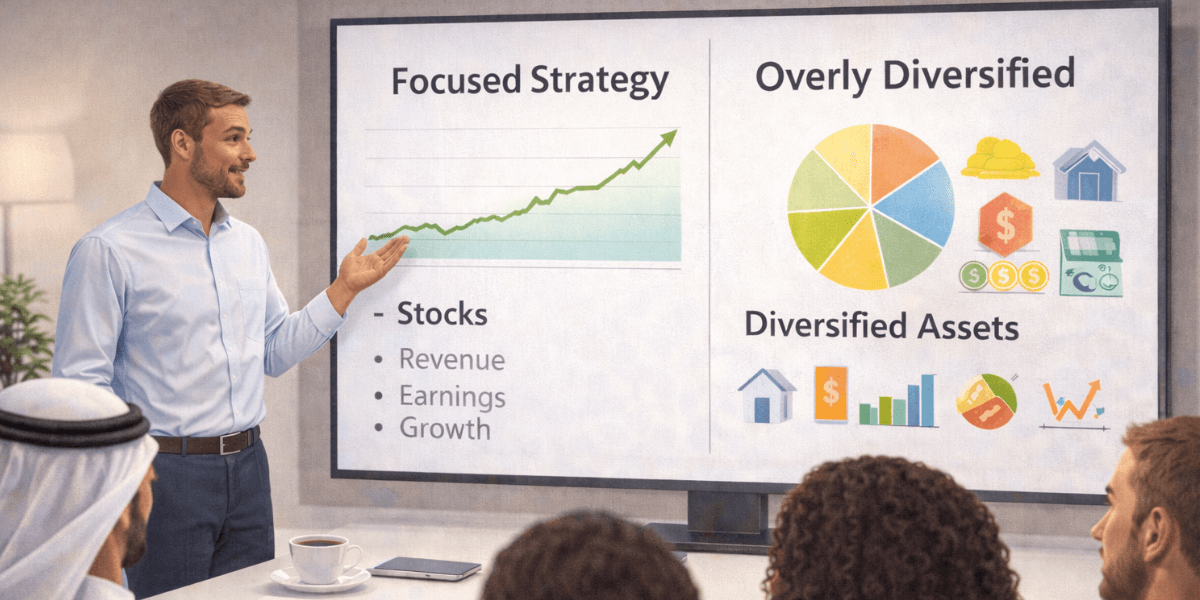
A senior-level analysis explaining when stocks make more sense than diversified asset trading, focusing on correlation risk, time horizons, ...
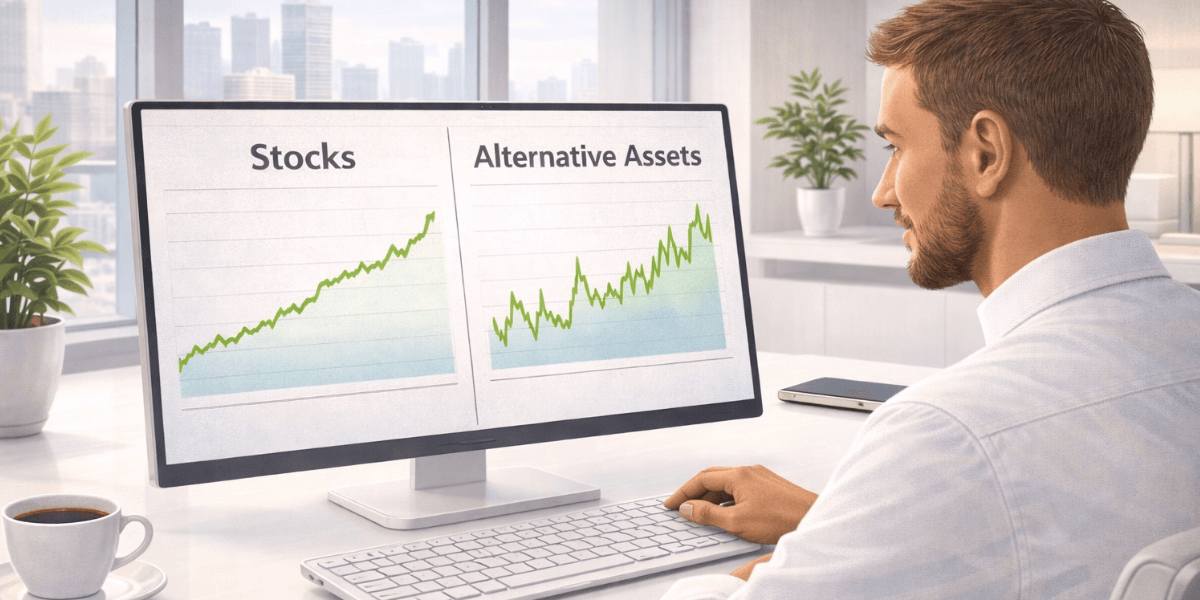
A senior-level analysis comparing stocks and alternative assets from a conservative investing perspective, explaining capital durability, tr...

A senior-level analysis explaining why stocks are fundamentally easier to analyze than other assets, focusing on cash flows, accounting stru...

A senior-level risk analysis comparing stocks and speculative assets, explaining how permanent capital risk, time horizons, and recovery dyn...