Overview of the Bahrain Stock Exchange (Bahrain Bourse)
A comprehensive overview of the Bahrain Stock Exchange (Bahrain Bourse), analyzing its market structure, regulation, liquidity characteristi...
When long-term investors compare stocks with other asset classes, the discussion often becomes fragmented. Real estate is praised for its tangibility, bonds for their stability, gold for its role as a store of value, and cash for its liquidity. While each of these assets can play a role in a portfolio, this way of thinking obscures the core issue: long-term investing is not about holding many assets, but about identifying which assets are structurally capable of compounding wealth over decades.
This distinction is particularly relevant for investors based in GCC countries. Many investors in the region enjoy relatively strong cash flow, exposure to USD-pegged currencies, and access to global markets. At the same time, domestic investment opportunities are often concentrated, cyclical, or limited in scale. As a result, long-term wealth creation from the GCC is rarely a local exercise; it is a global one. Choosing the right core asset class therefore matters more than tactical diversification across instruments that may not compound meaningfully.
Long-term investing rewards assets that grow alongside economic productivity. Over decades, wealth is not built by price movements alone, but by reinvestment, earnings growth, and scalability. Assets that generate cash flow, reinvest capital efficiently, and adapt to inflation and technological change have a structural advantage. Assets that merely preserve value or rely on scarcity narratives may protect purchasing power, but they do not inherently grow it.
For GCC-based investors, this structural lens is essential. Real estate markets are often tied to regional economic cycles and regulatory shifts. Fixed-income instruments are sensitive to global interest rate regimes. Commodities fluctuate with supply-demand dynamics that do not compound over time. Meanwhile, global equities provide exposure to innovation, global consumption, and productivity growth that transcends local conditions.
This article compares stocks with other major asset classes from the perspective of a long-term investor. The goal is not to dismiss diversification or to claim that equities are risk-free, but to explain why stocks consistently occupy the central role in long-horizon portfolios. By focusing on structure rather than sentiment, especially in the context of GCC investors accessing global markets, the comparison becomes clearer: long-term investing is ultimately about choosing assets that are designed to grow.
Stocks are fundamentally different from most other assets because they represent ownership, not claims or stores of value. When an investor buys shares of a company, they acquire a stake in an operating business that generates revenue, reinvests capital, innovates, and grows alongside the broader economy.
Over long periods, corporate earnings tend to grow with population growth, productivity gains, and technological advancement. This creates a natural compounding mechanism that does not rely on timing or price appreciation alone. Dividends, reinvested earnings, and expansion into new markets all contribute to long-term returns.
For GCC investors investing internationally, stocks provide exposure to global growth engines rather than local economic cycles. This makes equities uniquely suited for long-term capital growth in a region where domestic equity markets may be smaller or more concentrated.
Bonds are often described as safer than stocks, but this safety comes at a structural cost. Bonds represent a fixed claim on future cash flows, not ownership in growth. Their returns are largely defined at issuance and are heavily influenced by interest rate environments.
Over long horizons, bond returns tend to lag equity returns because they do not benefit meaningfully from economic expansion. Inflation further erodes real returns, particularly in periods of rising prices.
For long-term investors in the GCC, bonds may play a role in capital preservation or income generation, but they are poorly suited as a primary growth engine. Their value lies in risk moderation, not wealth accumulation.
Real estate is often favored by investors for its tangibility and perceived stability. Property can generate rental income and appreciate over time, but it is structurally illiquid and capital-intensive.
Returns are heavily influenced by local economic conditions, regulatory environments, and financing costs. Unlike stocks, real estate does not scale efficiently; diversification requires significant capital and operational involvement.
For GCC investors, local real estate markets can be attractive but are often closely tied to regional economic cycles and regulatory shifts. As a long-term growth asset, real estate lacks the global scalability and compounding efficiency of equities.
Gold has historically been viewed as a store of value rather than a growth asset. It does not generate income, dividends, or reinvestment opportunities. Its long-term return profile is driven primarily by inflation hedging and shifts in investor sentiment.
While gold can preserve purchasing power over long periods, it does not compound wealth in the way productive assets do. Long-term returns tend to be flat after adjusting for inflation.
For GCC investors, gold may serve as a hedge or portfolio stabilizer, but it is structurally unsuitable as a core long-term investment vehicle.
Cash offers liquidity and certainty, but it carries the highest long-term cost: loss of purchasing power. Inflation steadily erodes the real value of cash holdings.
While holding cash is necessary for flexibility and short-term needs, long-term investors who hold excessive cash are effectively opting out of compounding.
In the GCC, where currencies are often USD-pegged, inflation risk is sometimes underestimated. Over decades, even modest inflation significantly reduces real wealth.
Alternative assets such as private equity, commodities, or collectibles are often marketed as diversification tools. While some alternatives can deliver strong returns, they typically require specialized knowledge, access, and tolerance for illiquidity.
Many alternatives lack transparency and consistent long-term performance data. Their success often depends on manager skill rather than structural growth.
For most GCC-based long-term investors, alternatives may complement a portfolio but are unlikely to replace equities as a primary growth driver.
Across decades and geographies, equities have demonstrated superior long-term real returns compared to most other asset classes. This is not accidental. Stocks are tied directly to economic productivity and innovation.
Equities benefit from reinvested earnings, global expansion, and technological disruption. They adjust dynamically to inflation through pricing power and revenue growth.
For GCC investors with access to global stock markets, equities provide exposure to industries, technologies, and regions that are not available locally, enhancing diversification and growth potential.
Stocks are often perceived as risky because of short-term volatility. Prices fluctuate daily, sometimes violently. However, this volatility is largely noise over long horizons.
The real risk for long-term investors is not volatility, but missing compounding by avoiding equities altogether. Time reduces equity risk because economic growth unfolds gradually.
For long-term investors in the GCC, embracing equity volatility as a feature rather than a flaw is key to capturing long-term returns.
Every asset class has strengths, weaknesses, and appropriate use cases. Bonds provide stability and predictable income, but sacrifice long-term growth. Real estate offers tangibility and cash flow, but ties capital to illiquidity and local economic cycles. Gold preserves purchasing power, but does not generate income or compound capital. Cash offers flexibility, but guarantees erosion of real value over time. Alternative assets introduce diversification and occasional upside, but often rely on complexity, illiquidity, or specialized access rather than scalable growth.
Stocks stand apart not because they are free of risk, but because they are structurally aligned with long-term economic expansion. Equities represent ownership in businesses that generate revenue, reinvest profits, innovate, and adapt. Over long horizons, these businesses benefit from population growth, productivity improvements, technological change, and global market integration. This creates a compounding mechanism that no other widely accessible asset class can replicate at scale.
For investors based in GCC countries, this structural advantage is particularly meaningful. Global equities provide exposure to industries, technologies, and consumption patterns that are not always present in local markets. They allow investors to participate in worldwide growth rather than relying solely on regional cycles. While short-term volatility can be uncomfortable, it is the price paid for access to long-term compounding.
The perception of stocks as “risky” often stems from a short-term mindset. Price fluctuations are visible and frequent, whereas the slow erosion of purchasing power in cash or low-yield assets is subtle. Over decades, however, the greater risk is not volatility, but the failure to compound. Investors who avoid equities entirely in the name of stability often sacrifice the very growth required to preserve and expand wealth in real terms.
This does not mean that long-term portfolios should consist exclusively of stocks. Diversification remains important for managing drawdowns, liquidity needs, and behavioral comfort. But diversification works best when built around a strong core. For most long-term investors—particularly those in the GCC with access to global markets—stocks are that core.
Long-term investing is ultimately about aligning capital with assets that grow alongside the global economy. When evaluated through this lens, stocks are not just one option among many. They are the foundation upon which sustainable, long-term wealth is built.
Stocks are not universally superior in every scenario, but they are structurally best suited for long-term growth when compared to most other assets.
No. Local assets can play a role, but global equities provide diversification and growth opportunities not always available domestically.
Historically, broad equity markets have recovered over time as economies adapt and grow.
Yes. Diversification within equities and across complementary assets helps manage risk without sacrificing growth.
Disclaimer: This content is for education only and is not investment advice.

A comprehensive overview of the Bahrain Stock Exchange (Bahrain Bourse), analyzing its market structure, regulation, liquidity characteristi...

An in-depth analysis of the Kuwait Stock Exchange (Boursa Kuwait), explaining its structure, regulation, market behavior, and strategic rele...
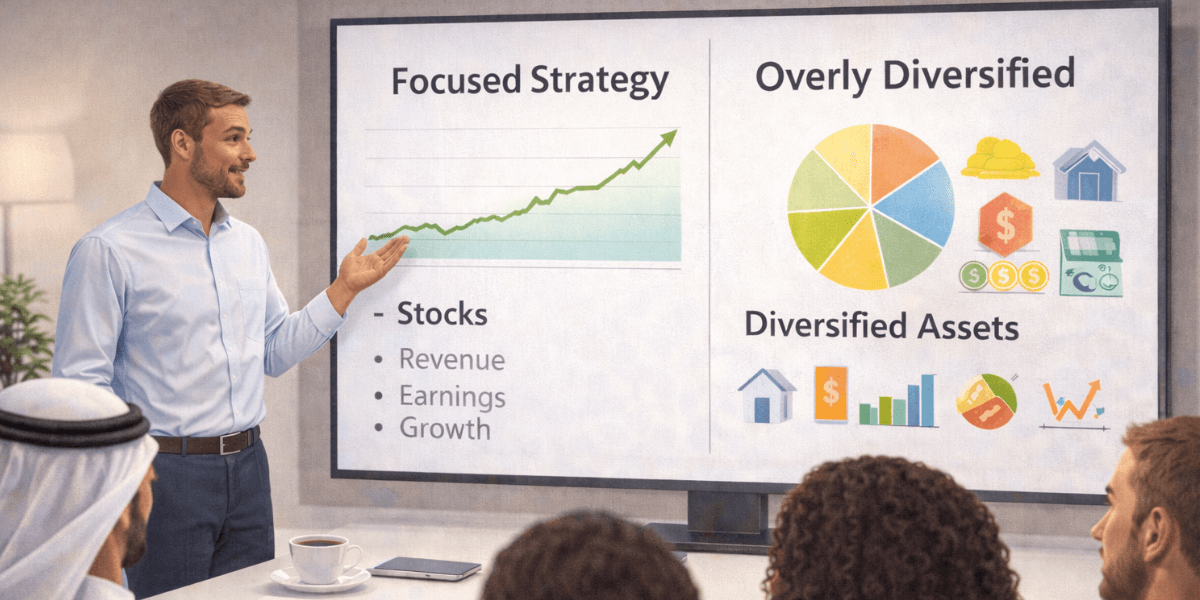
A senior-level analysis explaining when stocks make more sense than diversified asset trading, focusing on correlation risk, time horizons, ...
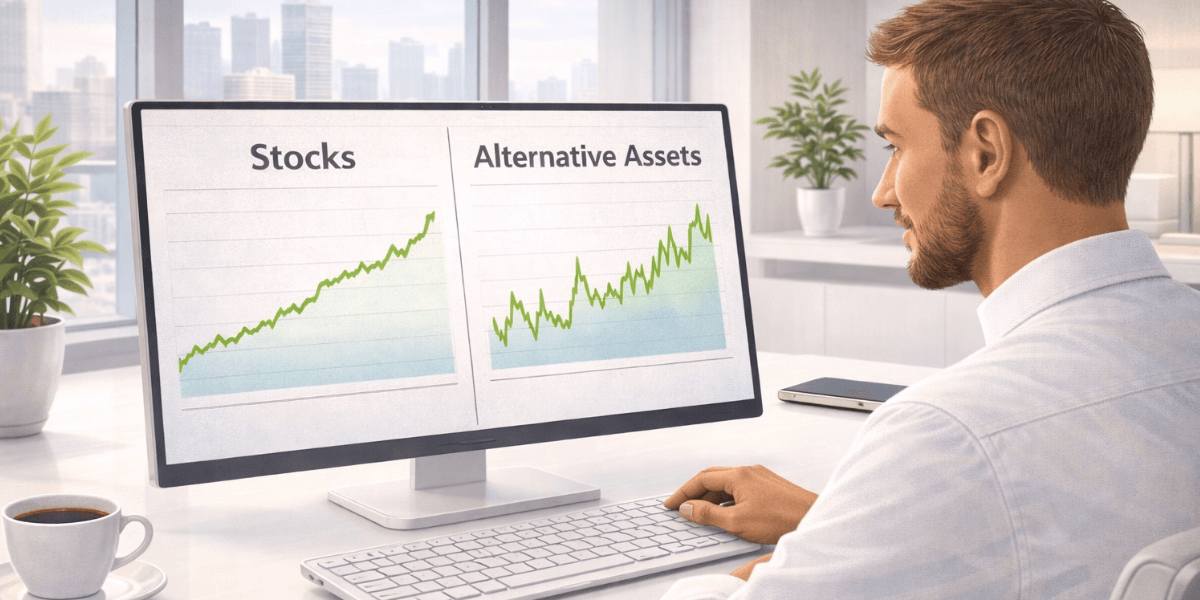
A senior-level analysis comparing stocks and alternative assets from a conservative investing perspective, explaining capital durability, tr...

A senior-level analysis explaining why stocks are fundamentally easier to analyze than other assets, focusing on cash flows, accounting stru...

A senior-level risk analysis comparing stocks and speculative assets, explaining how permanent capital risk, time horizons, and recovery dyn...