Overview of the Bahrain Stock Exchange (Bahrain Bourse)
A comprehensive overview of the Bahrain Stock Exchange (Bahrain Bourse), analyzing its market structure, regulation, liquidity characteristi...
Momentum in stocks is often treated as a purely technical phenomenon, something that appears on price charts through indicators, breakouts, or accelerating trends. This interpretation is incomplete. Charts do not create momentum; they reveal it. Momentum is created by underlying forces that move capital, shape expectations, and influence how market participants behave over time.
Understanding what actually creates momentum is essential for anyone trading or investing in equities. Without this understanding, momentum trading degenerates into chasing price without context. With it, momentum becomes a structured response to identifiable drivers such as information flow, institutional behavior, liquidity conditions, and human psychology.
For traders operating from GCC countries, this understanding is especially important. Global equity markets—particularly U.S. markets—often move outside local business hours. Reacting to momentum after it is already obvious on the chart can be costly. Traders who understand what creates momentum can anticipate where it is likely to emerge and position themselves with preparation rather than reaction.
This article explains what creates momentum in stocks from the ground up. The focus is strictly on equities and on traders accessing global stock markets from the GCC. The goal is to move beyond surface-level explanations and examine the structural, behavioral, and informational forces that generate sustained price movement.
One of the primary drivers of momentum is the way new information enters markets. Information does not reach all participants at the same time, nor is it interpreted uniformly. Earnings reports, guidance changes, macroeconomic data, regulatory decisions, and industry developments are absorbed gradually.
Large institutional investors must analyze, validate, and act on information through committees, risk controls, and execution processes. This creates delays between information release and full capital reallocation. During this period, prices begin to move as early participants act, and momentum starts to build.
This uneven absorption of information is structural. It exists in all major equity markets and across timeframes, making it a persistent source of momentum rather than a temporary anomaly.
Momentum is heavily influenced by institutional behavior. Large funds cannot buy or sell significant positions instantly without moving price against themselves. As a result, institutional accumulation and distribution occur over multiple sessions or weeks.
As buying pressure persists, price trends develop. Other market participants observe these trends and begin to participate, reinforcing momentum. This feedback loop continues until positioning becomes saturated or new information alters expectations.
Momentum, in this sense, is a byproduct of scale. It exists because large capital moves slowly relative to market liquidity.
Liquidity plays a critical role in momentum creation. When demand exceeds available supply at current prices, price must rise to attract sellers. In thinly supplied markets or stocks with limited float, this effect is magnified.
Conversely, when selling pressure overwhelms available buyers, prices fall persistently. These imbalances are rarely resolved in a single session. They unfold over time, creating sustained movement.
Momentum traders who understand liquidity dynamics can identify environments where continuation is more likely than mean reversion.
Momentum feeds on visibility. Stocks that outperform their peers or the broader market attract attention from analysts, media, and other investors. This attention brings additional capital.
As relative performance improves, benchmarks and quantitative strategies may be forced to increase exposure. This mechanical buying reinforces momentum independently of discretionary judgment.
Relative strength is therefore not just a signal; it is a mechanism that pulls capital into already-moving stocks.
Markets are driven by people, and people respond emotionally to price movement. Rising prices create optimism and fear of missing out. Falling prices create fear and urgency to exit.
These emotional responses are not instantaneous. They build over time as narratives form and confidence shifts. As more participants align emotionally with price direction, momentum accelerates.
This psychological reinforcement explains why momentum often overshoots fundamental value before reversing.
Momentum is often strengthened when narratives align with price movement. Analyst upgrades, target price increases, and positive media coverage provide justification for existing trends.
These revisions rarely occur at the beginning of a move. They tend to follow initial price action, reinforcing it rather than initiating it. This lag contributes to continuation.
Momentum traders who monitor narrative evolution gain insight into whether a move is being validated or questioned.
Momentum rarely exists in isolation. Sector rotation and market-wide themes create secondary momentum effects. When capital flows into a sector, individual stocks benefit regardless of company-specific news.
This top-down momentum can persist as long as the broader theme remains intact. Stocks aligned with strong sectors often exhibit more durable trends.
Ignoring sector context increases the risk of misinterpreting momentum strength.
Momentum behaves differently under different volatility regimes. In stable environments, trends can persist smoothly. In high-volatility environments, momentum may be faster but less predictable.
Understanding volatility context helps traders adjust expectations and risk management. Momentum does not disappear in volatile markets, but it changes character.
For GCC-based traders, awareness of volatility regimes is crucial when markets move overnight.
Many strong momentum moves emerge after periods of consolidation. During consolidation, supply and demand reach temporary balance. Energy builds as participants reposition.
When this balance breaks, price can move rapidly as trapped participants exit and new participants enter. Momentum is created by the release of accumulated imbalance.
This is why breakouts often lead to sustained moves rather than immediate reversals.
Momentum is not permanent. It fades when the forces that created it weaken. Institutional positioning completes, narratives lose credibility, liquidity conditions change, or new information contradicts existing expectations.
Understanding what ends momentum is as important as understanding what creates it. Exhaustion, crowding, and divergence between price and fundamentals often signal decay.
Momentum traders focus on participation, not permanence.
Traders in the GCC operate with limited ability to react intraday. Understanding what creates momentum allows anticipation rather than reaction.
By identifying the forces behind price movement, traders can plan entries, manage risk, and avoid chasing late-stage moves.
This structural understanding turns momentum trading from guesswork into analysis.
Momentum in stocks is not a mystery and it is not a technical illusion created by charts or indicators. It is the natural outcome of how markets function when information, capital, and human behavior interact over time. Prices do not adjust instantly to new realities. They adjust gradually, unevenly, and often imperfectly. Momentum exists in the space between information becoming known and that information being fully reflected in price.
Understanding what creates momentum changes how traders interact with markets. Instead of reacting to price movement after it becomes obvious, traders can analyze the underlying forces that make continuation likely or unlikely. Institutional accumulation, liquidity constraints, relative performance, narrative alignment, and psychological reinforcement are not abstract concepts. They are measurable dynamics that shape how trends develop and how long they persist.
For traders operating from GCC countries, this understanding is particularly valuable. Structural constraints such as time zone differences, limited ability to monitor markets intraday, and exposure to overnight moves make reactive trading dangerous. Traders who rely only on visual momentum signals often enter late, manage risk poorly, and exit emotionally. By contrast, traders who understand what creates momentum can plan trades in advance, size risk appropriately, and avoid participating when momentum is already exhausted.
Momentum should therefore be viewed as a process, not an event. It builds, accelerates, and eventually decays as the forces behind it evolve. Successful traders do not assume momentum will last forever, nor do they fear it simply because prices have moved. They evaluate whether the drivers that created momentum are still active and whether the balance between opportunity and risk remains favorable.
Ultimately, momentum trading becomes sustainable only when it is grounded in understanding rather than imitation. Charts show where momentum is visible, but analysis explains why it exists. For equity traders seeking consistent participation in global markets from the GCC, this distinction is decisive. Momentum is not something to chase. It is something to recognize, contextualize, and engage with deliberately.
No. News can initiate momentum, but capital flows, liquidity, and psychology sustain it.
No. Momentum is more likely in liquid stocks with institutional participation.
Yes, temporarily. But durable momentum often aligns with some fundamental justification.
Because the forces sustaining it weaken or new information disrupts expectations.
Disclaimer: This content is for education only and is not investment advice.

A comprehensive overview of the Bahrain Stock Exchange (Bahrain Bourse), analyzing its market structure, regulation, liquidity characteristi...

An in-depth analysis of the Kuwait Stock Exchange (Boursa Kuwait), explaining its structure, regulation, market behavior, and strategic rele...

A senior-level analysis explaining when stocks make more sense than diversified asset trading, focusing on correlation risk, time horizons, ...
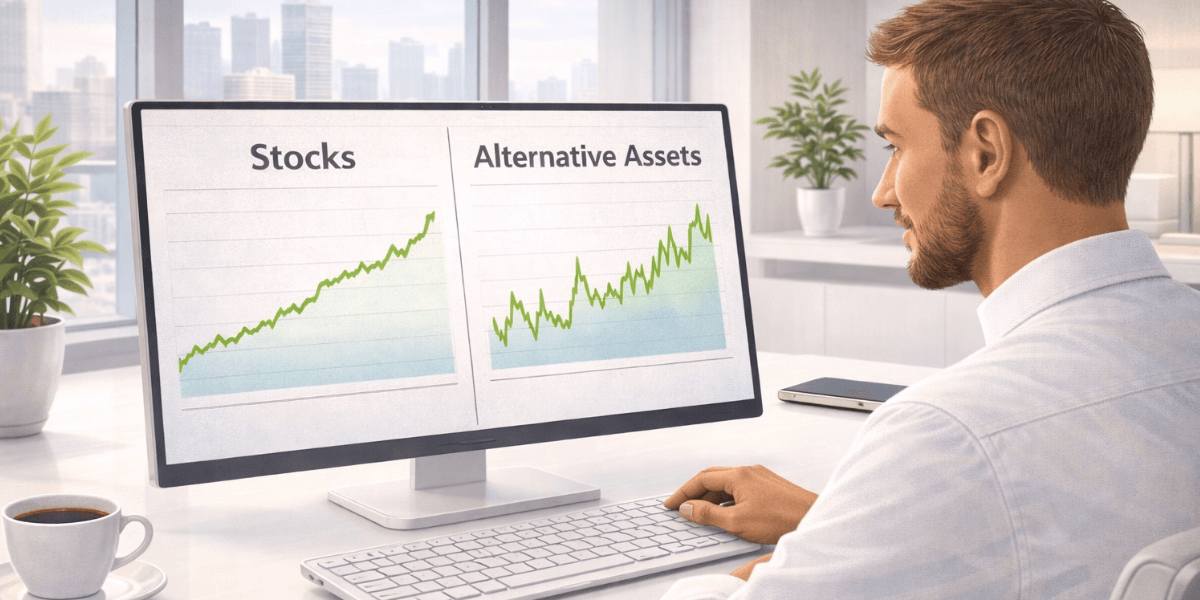
A senior-level analysis comparing stocks and alternative assets from a conservative investing perspective, explaining capital durability, tr...

A senior-level analysis explaining why stocks are fundamentally easier to analyze than other assets, focusing on cash flows, accounting stru...

A senior-level risk analysis comparing stocks and speculative assets, explaining how permanent capital risk, time horizons, and recovery dyn...