Overview of the Bahrain Stock Exchange (Bahrain Bourse)
A comprehensive overview of the Bahrain Stock Exchange (Bahrain Bourse), analyzing its market structure, regulation, liquidity characteristi...
Earnings season is one of the most influential and misunderstood periods in the stock market. It is often described as the time when companies report their quarterly financial results, but this definition barely scratches the surface of its true importance. Earnings season is not simply a reporting calendar; it is the moment when market expectations, narratives, and assumptions are tested against actual business performance. Prices do not move because numbers are released. They move because those numbers confirm, challenge, or completely dismantle what investors believed would happen.
For investors in the GCC, earnings season carries particular weight. Most GCC-based equity investors allocate capital to U.S. and global markets, where earnings season drives a significant portion of short-term volatility and long-term repricing. These markets are highly forward-looking, densely covered by analysts, and deeply sensitive to expectation shifts. Understanding earnings season is therefore not optional for serious stock investors in the region; it is a core competency.
Many investors approach earnings season emotionally. They anticipate reports with excitement or fear, hoping for beats, dreading misses, and reacting impulsively to price movements. This behavior often leads to poor decisions, such as chasing stocks after strong reports or selling quality businesses after temporary disappointments. The root cause is a misunderstanding of what earnings season actually represents. It is not a judgment on past performance; it is a reassessment of future potential.
Earnings season compresses information. In a short period of time, thousands of companies update the market on revenue trends, cost pressures, margins, guidance, and strategic priorities. This influx of information forces investors to re-evaluate assumptions quickly. For long-term investors, the challenge is not reacting faster, but interpreting more intelligently.
Another reason earnings season matters is that it reveals how businesses behave under real-world conditions. Forecasts and narratives dominate markets between reports. Earnings season introduces friction. Supply chains, demand shifts, pricing power, and cost inflation all become visible. This visibility allows investors to distinguish between companies that merely benefit from favorable narratives and those that execute consistently.
For GCC investors building long-horizon portfolios, earnings season should not be viewed as a trading event. It should be treated as a diagnostic window into business quality. Understanding how to read earnings season properly helps investors avoid emotional reactions, identify long-term trends early, and allocate capital more effectively across global markets.
Earnings season refers to the period when publicly traded companies release their quarterly financial results. In most major markets, particularly the United States, earnings season occurs four times a year and spans several weeks. During this period, companies report income statements, balance sheet updates, cash flow information, and management commentary.
However, earnings season is not evenly distributed. Large, influential companies report early, shaping market sentiment for entire sectors. Smaller companies follow, often reacting to the tone set by industry leaders. This sequencing matters because expectations are adjusted continuously as results unfold.
For global investors, including those in the GCC, earnings season creates a feedback loop. Early reports influence expectations for later reporters, and sector-wide narratives can change rapidly. Understanding this dynamic helps investors contextualize individual company results within broader market movements.
Earnings season is synonymous with volatility, but volatility does not necessarily indicate instability. It reflects uncertainty being resolved. Before earnings are released, prices incorporate a range of possible outcomes. When results arrive, that range collapses into a narrower set of expectations, causing price adjustments.
Importantly, volatility does not require bad news. Stocks often move sharply even when companies report solid results. This happens because the market is reacting to differences between expectations and reality, not to absolute performance. A strong quarter can still disappoint if growth is slowing or guidance is cautious.
For GCC investors unfamiliar with this mechanism, earnings season volatility can feel irrational. In reality, it is the market doing what it is designed to do: reprice assets based on new information.
Expectations dominate earnings season outcomes. Analyst forecasts, management guidance, and prior performance shape what the market anticipates. By the time a company reports, much of the information is already reflected in the stock price.
This is why surprises matter more than results. A small deviation from expectations can trigger large price movements, while strong headline numbers may have little effect if they were already anticipated. For long-term investors, this underscores the importance of understanding positioning rather than reacting to news.
One of the most overlooked aspects of earnings season is management guidance. While reported earnings describe the past, guidance shapes expectations for the future. Markets care far more about where a business is going than where it has been.
A company can deliver strong earnings but lower future guidance due to macro uncertainty, cost pressures, or strategic shifts. In such cases, stock prices often decline despite positive results. For GCC investors, learning to read guidance language and tone is essential to interpreting earnings season correctly.
Earnings season reveals which business models are resilient and which are fragile. Companies with pricing power, recurring revenue, and diversified demand tend to navigate earnings season with less disruption. Those dependent on cyclical demand or narrow markets often show greater volatility.
For long-term investors, this resilience is more important than short-term beats or misses. Earnings season provides repeated opportunities to observe how businesses perform under varying conditions, offering insight into long-term durability.
Earnings season often triggers sector rotation. Strong results in one sector can attract capital, while weak performance elsewhere leads to outflows. These shifts are driven by changing expectations about growth, profitability, and risk.
For GCC investors with diversified global portfolios, understanding these rotations helps explain relative performance and prevents overreaction to isolated stock movements.
Long-term investors should approach earnings season as observers, not participants in short-term reactions. The objective is to assess whether new information alters long-term earnings power, competitive positioning, or capital allocation quality.
Most earnings-related price movements do not affect intrinsic value. Reacting impulsively often leads to buying high and selling low. A disciplined approach focuses on trend confirmation rather than single-quarter outcomes.
Earnings season is often treated as a scoreboard that determines winners and losers, but this perspective misses its true purpose. It is not a final judgment on companies; it is a recurring checkpoint where assumptions are tested and narratives refined. For long-term investors, especially those in the GCC allocating capital across global markets, earnings season should be approached as a source of information rather than a trigger for action.
The most valuable insight earnings season provides is not whether a company beat or missed expectations, but whether its long-term earnings trajectory remains intact. Businesses that consistently deliver stable performance, adapt to changing conditions, and communicate transparently tend to emerge stronger over time, regardless of short-term volatility.
For GCC investors, distance from underlying markets makes disciplined interpretation even more important. Emotional reactions to earnings headlines can erode returns, while patient analysis can uncover opportunities created by temporary mispricing. Earnings season rewards preparation, not speed.
Ultimately, earnings season matters because it forces reality into the market. It exposes weaknesses, confirms strengths, and reshapes expectations. Investors who understand this process gain clarity and confidence, while those who chase reactions remain vulnerable to noise.
For long-term stock investors, mastering earnings season is not about predicting price moves. It is about learning how markets process information and using that understanding to make better decisions over time. When approached correctly, earnings season becomes less intimidating and far more informative.
Earnings season occurs four times a year, following the end of each fiscal quarter.
Because prices react to expectations and future outlook, not just reported results.
Generally no. Long-term investors benefit more from analysis than from short-term trading.
Because most GCC investors allocate capital globally, where earnings season drives major repricing and narrative shifts.
Disclaimer: This content is for education only and is not investment advice.

A comprehensive overview of the Bahrain Stock Exchange (Bahrain Bourse), analyzing its market structure, regulation, liquidity characteristi...

An in-depth analysis of the Kuwait Stock Exchange (Boursa Kuwait), explaining its structure, regulation, market behavior, and strategic rele...
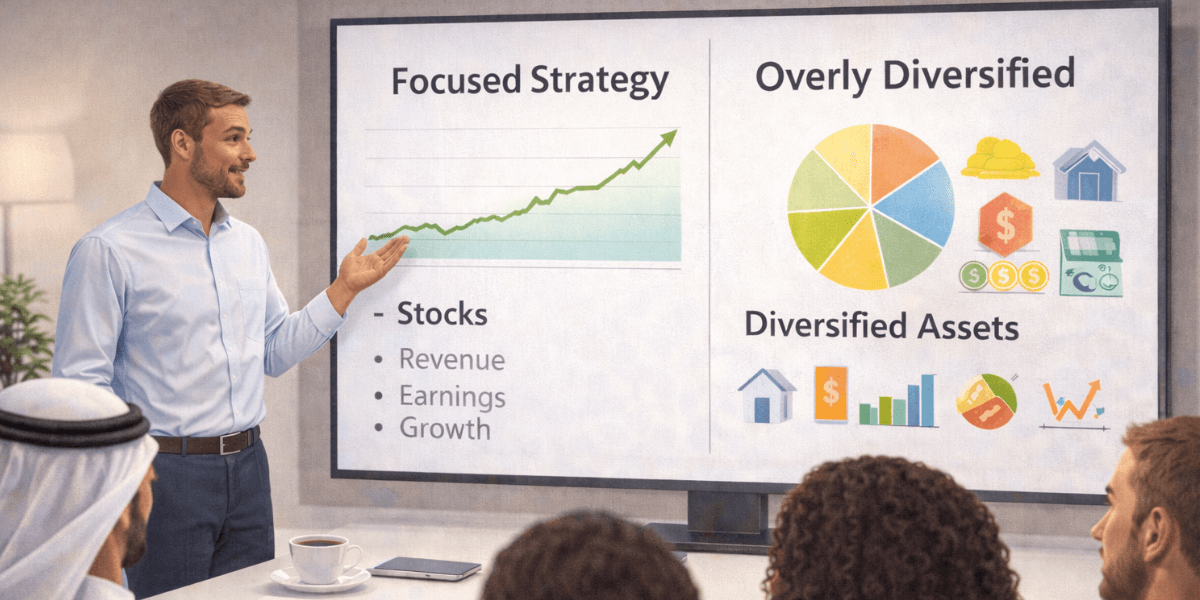
A senior-level analysis explaining when stocks make more sense than diversified asset trading, focusing on correlation risk, time horizons, ...

A senior-level analysis comparing stocks and alternative assets from a conservative investing perspective, explaining capital durability, tr...

A senior-level analysis explaining why stocks are fundamentally easier to analyze than other assets, focusing on cash flows, accounting stru...

A senior-level risk analysis comparing stocks and speculative assets, explaining how permanent capital risk, time horizons, and recovery dyn...