Overview of the Bahrain Stock Exchange (Bahrain Bourse)
A comprehensive overview of the Bahrain Stock Exchange (Bahrain Bourse), analyzing its market structure, regulation, liquidity characteristi...
The Dubai Financial Market, commonly known as DFM, occupies a unique position within the GCC investment landscape. It is neither a frontier market driven purely by speculation nor a fully mature exchange comparable to New York or London. Instead, DFM reflects the economic structure, capital flows, and strategic ambitions of the United Arab Emirates, particularly Dubai’s role as a regional financial hub. For investors operating in the GCC, understanding DFM is not optional—it is foundational.
DFM is more than a place where shares change hands. It is an institutional mechanism through which domestic savings, regional capital, and international investment converge. It mirrors the evolution of Dubai itself: a city-state that transformed from a trade-centric economy into a diversified financial and commercial center within a single generation. As such, the market’s behavior cannot be understood purely through classical Western market frameworks. Local liquidity patterns, government participation, family-owned conglomerates, Sharia considerations, and regional sentiment all play decisive roles.
Many GCC investors approach DFM with assumptions imported from U.S. or European equity markets, expecting similar liquidity depth, sector balance, and valuation behavior. This often leads to confusion. DFM is structurally different. Sector concentration is higher. Retail participation is more visible. Government-linked entities play a significant role. Volatility clusters around specific events rather than flowing evenly across time. These characteristics are not weaknesses; they are features of a market embedded in a specific economic and cultural context.
This article provides a deep, professional explanation of what the Dubai Financial Market is, how it operates, and why it matters for investors in the GCC. We will explore its origins, regulatory framework, trading structure, listed companies, sector composition, and strategic role within the UAE and the wider Gulf region. The objective is not promotion, but clarity. Understanding DFM allows investors to allocate capital with intention rather than assumption.
The Dubai Financial Market was established in 2000 as part of Dubai’s broader strategy to build a transparent, regulated capital market capable of supporting economic diversification. Prior to DFM’s creation, equity trading in the UAE was informal and fragmented. The launch of a centralized exchange marked a decisive step toward institutionalization.
From the outset, DFM was designed to serve domestic and regional investors first, while remaining accessible to international capital. This dual mandate still defines the market today. It supports local companies seeking public capital, while also offering foreign investors exposure to UAE growth through a regulated venue.
Unlike markets that evolved organically over centuries, DFM was built deliberately. Regulation, technology, and governance were implemented in parallel. This top-down design influences how the market behaves: rules are clear, but liquidity and participation patterns are shaped by regional realities rather than historical inertia.
DFM operates under the supervision of the Securities and Commodities Authority (SCA) of the United Arab Emirates. This regulatory structure provides a centralized framework for licensing, disclosure, market conduct, and investor protection across UAE exchanges.
From a GCC investor’s perspective, regulation is one of DFM’s core strengths. Listing requirements, reporting standards, and corporate governance rules are well-defined and enforced. While the market may not offer the same breadth as global mega-exchanges, it compensates with regulatory clarity and consistency.
Importantly, DFM also aligns with the UAE’s broader financial architecture, which includes DIFC-based institutions, local banks, and regional asset managers. This integration enhances trust and facilitates capital flows within the ecosystem.
Trading on DFM follows a structured daily schedule that includes pre-opening, continuous trading, and closing phases. Orders are matched electronically, and price discovery occurs within clearly defined sessions.
Liquidity on DFM is concentrated rather than continuous. Activity tends to cluster around the market open, major announcements, and the close. Mid-session trading can be thinner, particularly in less actively traded names. This pattern reflects the strong presence of retail investors and regional institutions with defined operating hours.
For GCC investors, understanding these liquidity rhythms is essential. Execution quality depends not only on price, but on timing. DFM rewards patience and awareness more than constant activity.
DFM’s listed universe reflects the structure of Dubai’s economy. Financial services, real estate, construction, and transportation dominate market capitalization. Many listed entities are closely linked to government initiatives, infrastructure development, or strategic national projects.
Banks play a central role. UAE financial institutions listed on DFM are deeply embedded in the domestic economy, benefiting from population growth, trade flows, and government spending. Real estate developers also feature prominently, reflecting Dubai’s position as a global property hub.
This concentration means that DFM behaves differently from diversified global indices. Sector-specific events can have outsized impact. For investors, this increases the importance of understanding macro context rather than relying solely on bottom-up analysis.
Islamic finance is not a niche within DFM; it is part of the market’s fabric. Many listed companies operate under Sharia-compliant frameworks, and a significant portion of investor capital follows Islamic investment principles.
This influences product design, corporate structures, and investor behavior. While DFM is not exclusively Sharia-based, compliance considerations are more prominent than in Western markets. For GCC investors, this alignment often reduces friction between financial objectives and ethical frameworks.
However, Sharia alignment does not eliminate risk. Investors must still evaluate leverage, earnings quality, and governance. Compliance is a filter, not a guarantee.
DFM is open to foreign investors, and international participation has grown steadily over the past decade. Inclusion in global emerging market indices has increased visibility and passive inflows.
That said, domestic and regional investors still dominate day-to-day trading activity. This creates behavioral patterns distinct from markets driven primarily by institutional global capital. Sentiment, local news, and regional macro developments often move prices more than global risk factors.
For GCC investors, this familiarity can be an advantage. Local knowledge matters more on DFM than on highly efficient global exchanges.
Volatility on DFM tends to be episodic rather than constant. Long periods of relative calm can be followed by sharp moves triggered by earnings announcements, policy changes, or real estate developments.
This volatility structure reflects concentrated ownership and liquidity. When large participants act, prices adjust quickly. For investors accustomed to deep, continuously liquid markets, this can feel abrupt.
Understanding that volatility is structural—not random—helps investors avoid emotional reactions. DFM rewards preparation over speed.
Within the GCC, DFM occupies a complementary role alongside Tadawul in Saudi Arabia and the Abu Dhabi Securities Exchange (ADX). While Tadawul dominates in size and liquidity, DFM offers exposure to Dubai’s unique economic model.
For regional portfolios, DFM provides diversification within the Gulf. Its sector mix, investor base, and growth drivers differ meaningfully from other GCC exchanges.
This makes DFM particularly relevant for investors seeking regional balance rather than concentration.
For long-term investors in the GCC, DFM represents both opportunity and responsibility. Opportunity because it provides access to domestic growth, infrastructure development, and financial expansion. Responsibility because its structure demands informed participation.
DFM is not a market where passive assumptions work effortlessly. Understanding sector exposure, liquidity behavior, and regulatory context is essential. Investors who treat DFM as a simplified version of Western markets often misjudge risk.
Those who approach it on its own terms, however, gain access to a market aligned with regional growth trajectories.
The Dubai Financial Market is a reflection of Dubai itself: ambitious, structured, and shaped by regional realities. It is neither immature nor fully globalized. It occupies a deliberate middle ground that serves the UAE’s strategic objectives while integrating into international capital markets.
For GCC investors, understanding DFM means understanding how local economies translate into public markets. It means recognizing the influence of government-linked entities, Islamic finance, and regional liquidity patterns. It means accepting that market efficiency looks different outside Western frameworks.
DFM rewards investors who combine regional insight with disciplined analysis. It punishes those who assume familiarity where none exists. In a region where capital is increasingly sophisticated, DFM remains a core venue through which Gulf investors express conviction, allocate savings, and participate in economic growth.
Knowing what DFM is—and what it is not—is the first step toward using it effectively. Markets do not reward assumptions. They reward understanding.
The Dubai Financial Market is the main stock exchange of Dubai, providing a regulated platform for trading UAE-listed equities and other securities.
Yes. DFM operates under the supervision of the UAE Securities and Commodities Authority, ensuring regulatory oversight and investor protection.
Yes. Foreign investors are allowed to trade on DFM, subject to ownership limits that vary by company.
DFM has higher exposure to real estate and financial services, a strong retail investor presence, and liquidity patterns shaped by regional behavior.
Disclaimer: This content is for education only and is not investment advice.

A comprehensive overview of the Bahrain Stock Exchange (Bahrain Bourse), analyzing its market structure, regulation, liquidity characteristi...

An in-depth analysis of the Kuwait Stock Exchange (Boursa Kuwait), explaining its structure, regulation, market behavior, and strategic rele...

A senior-level analysis explaining when stocks make more sense than diversified asset trading, focusing on correlation risk, time horizons, ...
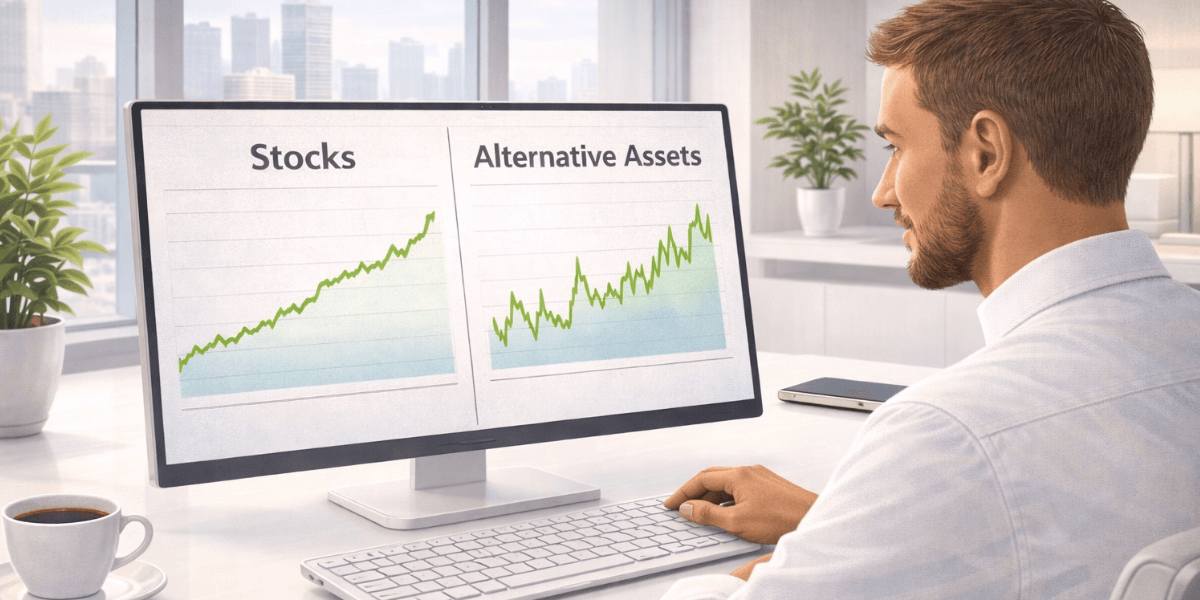
A senior-level analysis comparing stocks and alternative assets from a conservative investing perspective, explaining capital durability, tr...

A senior-level analysis explaining why stocks are fundamentally easier to analyze than other assets, focusing on cash flows, accounting stru...

A senior-level risk analysis comparing stocks and speculative assets, explaining how permanent capital risk, time horizons, and recovery dyn...