Overview of the Bahrain Stock Exchange (Bahrain Bourse)
A comprehensive overview of the Bahrain Stock Exchange (Bahrain Bourse), analyzing its market structure, regulation, liquidity characteristi...
In financial markets, the word “speculation” is often used loosely, usually as a synonym for volatility or short-term price movement. Stocks are labeled speculative when prices fluctuate sharply, while forex is sometimes presented as a more “technical” or “professional” market simply because it is driven by macroeconomic variables. This way of thinking confuses surface behavior with structural reality. Speculation is not defined by how frequently prices move or how complex the analysis appears. It is defined by how returns are generated and by how dependent success is on continuous prediction rather than participation in economic value creation.
This misunderstanding is particularly common among investors in GCC countries. Over the past decade, the region has been heavily targeted by forex marketing that emphasizes speed, leverage, and constant opportunity. Currency trading is often portrayed as a rational, skill-based activity where disciplined individuals can extract profits from global macro movements. At the same time, stock investing is frequently framed as risky or uncertain because equity prices visibly fluctuate and are influenced by sentiment. These narratives reverse the true structural roles of the two markets.
Stocks and forex are built on fundamentally different foundations. When an investor buys a stock, they acquire partial ownership in a company that produces goods or services, generates revenue, reinvests profits, and evolves alongside the broader economy. The investor’s return is linked to the long-term performance of that business and, by extension, to economic growth, productivity, and innovation. Even when stock prices decline temporarily, the underlying business continues to operate. Time does not invalidate ownership; it often strengthens it.
Forex trading, by contrast, involves no ownership of productive assets. A currency position represents a bet on the relative price movement between two monetary units. There is no underlying entity generating cash flow for the trader. Profits require directional accuracy within specific time windows, often amplified through leverage. While macroeconomic trends exist, they do not compound in a way that steadily reduces reliance on prediction. Each position remains exposed to policy shifts, interest rate changes, geopolitical events, and capital flows that can reverse without warning.
For investors in the GCC, this structural difference has practical consequences. Many investors in the region pursue long-term objectives: preserving purchasing power across generations, building globally diversified portfolios, and reducing dependence on local economic cycles. These objectives are better served by markets that reward patience, ownership, and compounding rather than constant engagement and tactical precision. Markets that demand continuous monitoring and high leverage introduce fragility, not efficiency.
This article explains why stocks are structurally less speculative than forex. The argument is not that stocks are risk-free or that forex is illegitimate. Rather, it is that speculation is defined by dependence on prediction and fragility to error. When evaluated through this lens, equities and currencies occupy very different positions. For GCC-based investors accessing global markets, understanding this distinction is essential for aligning financial strategy with long-term outcomes rather than short-term excitement.
When an investor buys a stock, they acquire an ownership stake in a real operating business. That business produces goods or services, generates revenue, incurs costs, reinvests capital, and adapts to changing economic conditions. The investor’s long-term return is tied to the company’s ability to grow earnings, maintain competitive advantages, and allocate capital effectively.
This ownership structure reduces speculation because returns do not depend solely on predicting short-term price movements. Even if prices fluctuate, the underlying business continues to operate. Time becomes an ally rather than an enemy, as earnings compound and value accumulates regardless of interim market noise.
Forex trading lacks this anchor. Currency traders do not own a productive asset; they speculate on relative price changes between two monetary units. Profits require correct timing and directional accuracy. There is no underlying entity creating value on behalf of the trader. This makes forex inherently more speculative, because outcomes are driven primarily by prediction rather than participation.
One of the most important reasons stocks are less speculative than forex is the presence of compounding. In equity markets, returns are driven by reinvested earnings, business expansion, dividends, and long-term economic growth. Over time, these forces dominate short-term price fluctuations.
Compounding reduces reliance on tactical decision-making. A stock investor does not need to be correct every month or even every year. As long as businesses grow over time, long-term returns emerge organically.
Forex markets do not compound in this way. Gains in one period do not create a self-reinforcing growth mechanism. Every trade resets the risk. Long-term success depends on continuous accuracy and discipline, which increases speculative exposure rather than reducing it.
Time is one of the clearest separators between investing and speculation. In stocks, longer time horizons generally reduce risk because economic growth, innovation, and productivity tend to unfold gradually. Volatility smooths out, and business fundamentals assert themselves.
In forex, time often increases uncertainty. Currency relationships are influenced by shifting interest rates, policy changes, geopolitical events, and capital flows. Long-term holding does not inherently reduce risk and may introduce additional costs through financing and rollover charges.
For GCC investors balancing investing with careers and businesses, markets that reward patience rather than constant attention are structurally less speculative.
Leverage is one of the defining characteristics of retail forex trading. Small price movements are magnified through borrowed capital, creating the possibility of large gains but also rapid losses. This amplification compresses time and margin for error.
Stocks can be traded with leverage, but long-term investors typically avoid or limit it. Unleveraged equity ownership allows investors to withstand volatility without forced liquidation.
In the GCC, where forex brokers frequently advertise extreme leverage, many participants underestimate how leverage turns normal market noise into existential risk. This fragility is a core feature of speculation.
Over long periods, stock markets are positive-sum. Businesses create value, expand markets, and increase productivity. While individual stocks can fail, the market as a whole grows alongside the economy.
Forex trading is closer to a zero-sum environment. Gains for one participant are offset by losses for another, after accounting for transaction costs. There is no aggregate value creation comparable to corporate earnings growth.
This structural difference makes forex outcomes more dependent on relative skill and timing, increasing speculative intensity.
Stock markets offer broad access to public information: financial statements, earnings calls, regulatory filings, and long-term data. While analysis is complex, the informational playing field is relatively transparent.
Forex markets are dominated by central banks, institutional flows, and macroeconomic forces that retail participants cannot anticipate or influence. Retail traders often react to information that institutions have already priced in.
For GCC investors without institutional infrastructure, this asymmetry further increases speculative risk in forex.
Speculation is not only structural, but psychological. Forex trading demands constant engagement, rapid reaction, and emotional control under leverage. This environment amplifies behavioral biases such as overtrading and loss chasing.
Stock investing, when approached long-term, reduces cognitive load by shifting focus from short-term price movement to business performance and portfolio structure.
Markets that reduce emotional strain are structurally less speculative and more sustainable.
For investors in GCC countries, long-term financial goals often include capital preservation, intergenerational wealth, and global diversification. These objectives align with assets that compound, scale globally, and reward patience.
Stocks provide access to global growth engines without requiring constant tactical decisions. Forex trading, while legitimate for specialized professionals, does not align structurally with long-term wealth building for most investors.
The tendency to label stocks as speculative and forex as sophisticated is rooted in surface-level observation rather than structural analysis. Stocks fluctuate visibly, while forex is often discussed in technical language involving interest rates, inflation, and central banks. However, speculation is not about how complex a market sounds or how quickly prices change. It is about how fragile outcomes are to error and how dependent success is on constant prediction.
Stocks are less speculative than forex because they are anchored to ownership in productive enterprises. When an investor owns shares in a company, they participate in an economic system that creates value over time. Businesses grow revenues, reinvest capital, innovate, and adapt to changing conditions. This process generates a compounding effect that gradually reduces the importance of short-term price movements. Over long horizons, returns are driven more by earnings growth than by timing.
Forex trading lacks this stabilizing mechanism. Currency positions do not benefit from reinvestment or internal growth. Gains in one period do not create a self-reinforcing process that improves future outcomes. Each trade remains exposed to abrupt regime changes, policy decisions, and shifts in capital flows. Leverage, which is central to retail forex trading, further compresses time and margin for error, transforming ordinary volatility into existential risk. This fragility is a defining characteristic of speculation.
For investors in GCC countries, these structural differences are amplified. Many participants are investing from a distance, across time zones, under foreign regulatory regimes, and alongside professional and personal responsibilities. Markets that require constant attention and rapid reaction impose psychological and operational burdens that are difficult to sustain over years or decades. In such environments, the cost of mistakes is not just financial but behavioral, often leading to overtrading and risk escalation.
This does not mean that forex has no role in global finance or that no one can profit from currency trading. Forex is a critical market for institutions managing capital flows, hedging exposures, and implementing macro strategies. Skilled professionals with appropriate infrastructure can operate within it successfully. However, treating forex as a long-term investment vehicle for the average retail investor is a structural mismatch, not a failure of discipline or education.
Stocks, despite their volatility, are structurally aligned with long-term wealth creation. They reward patience rather than constant action. They allow investors to benefit from global economic growth without needing to predict short-term price movements. For GCC-based investors with access to international equity markets, this alignment is decisive.
Ultimately, the difference between stocks and forex is not about excitement versus boredom, or speed versus patience. It is about whether returns are generated through ownership and compounding or through continuous prediction under leverage. When evaluated on this basis, stocks are clearly less speculative than forex. They are not free of risk, but their risk is compatible with long-term investing, whereas the risk structure of forex is inherently speculative.
Volatility alone does not define speculation. Stocks can be volatile while still being anchored to long-term value creation.
Forex trading is generally speculative because it lacks compounding and ownership, even though it can be profitable for professionals.
High leverage, aggressive marketing, and accessibility make forex visible, even though it carries higher structural risk.
No. Stocks carry market risk, but their risk profile improves over long horizons due to compounding and economic growth.
Disclaimer: This content is for education only and is not investment advice.

A comprehensive overview of the Bahrain Stock Exchange (Bahrain Bourse), analyzing its market structure, regulation, liquidity characteristi...

An in-depth analysis of the Kuwait Stock Exchange (Boursa Kuwait), explaining its structure, regulation, market behavior, and strategic rele...
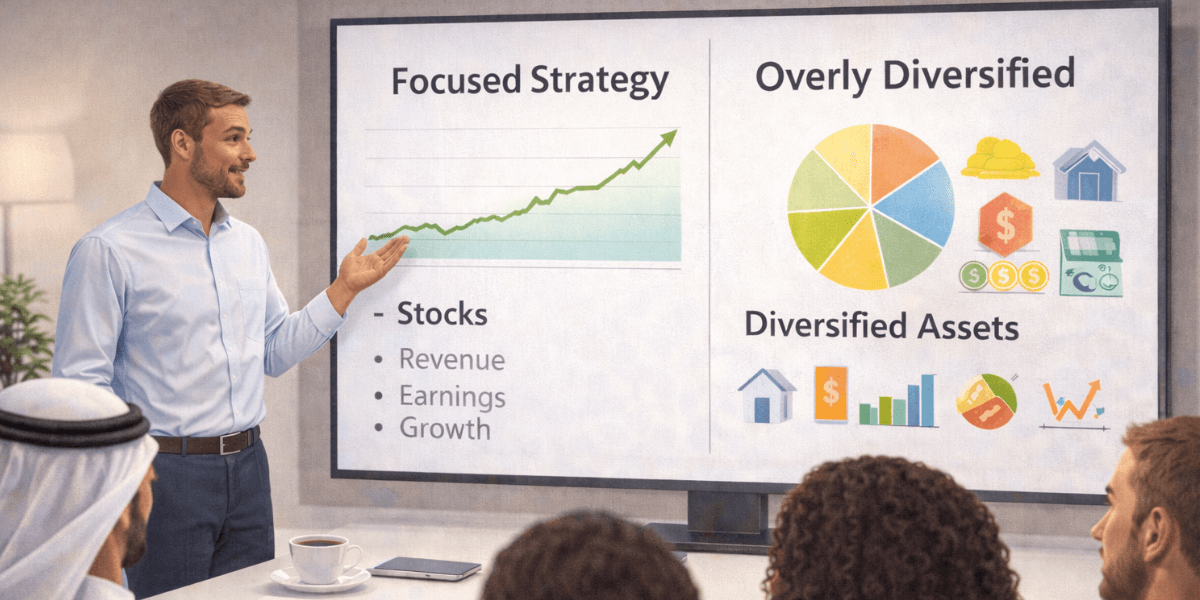
A senior-level analysis explaining when stocks make more sense than diversified asset trading, focusing on correlation risk, time horizons, ...
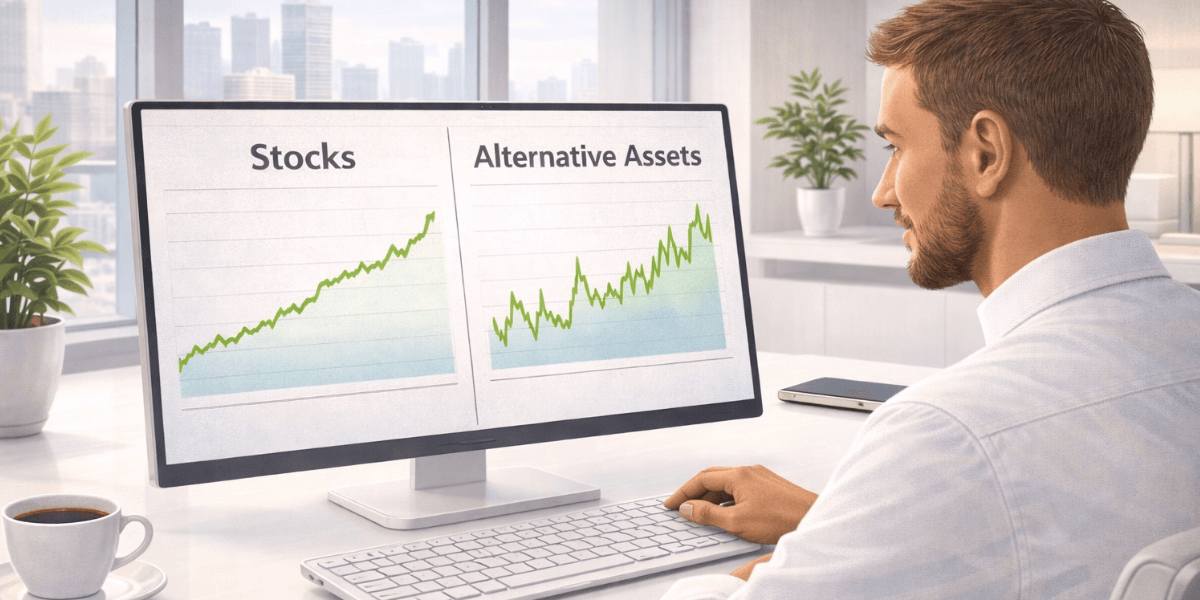
A senior-level analysis comparing stocks and alternative assets from a conservative investing perspective, explaining capital durability, tr...

A senior-level analysis explaining why stocks are fundamentally easier to analyze than other assets, focusing on cash flows, accounting stru...
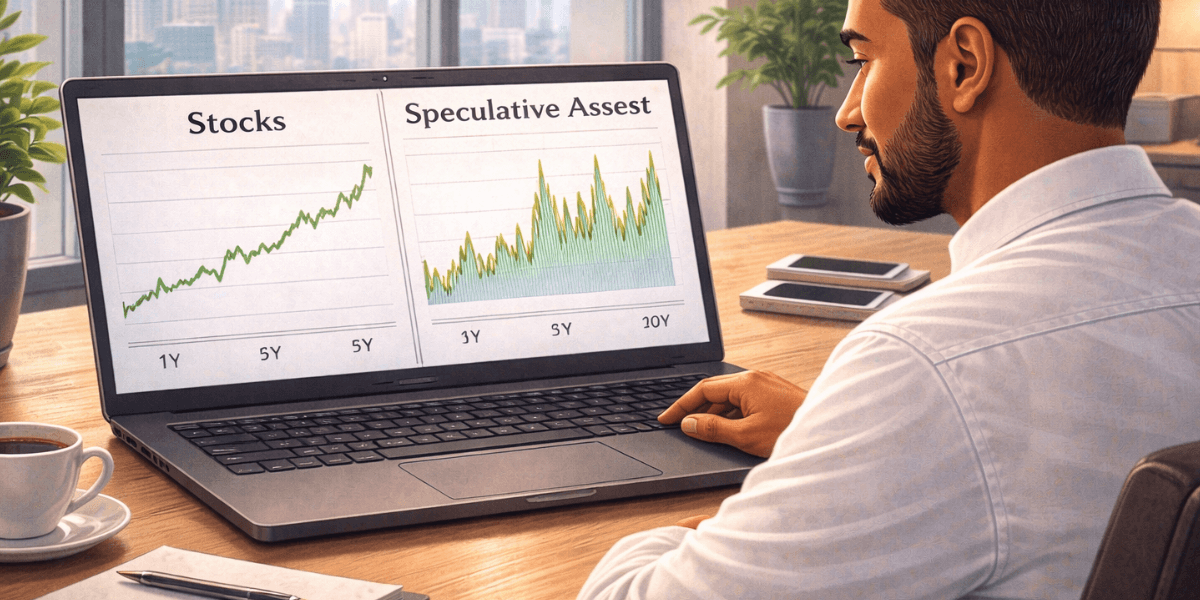
A senior-level risk analysis comparing stocks and speculative assets, explaining how permanent capital risk, time horizons, and recovery dyn...