Overview of the Bahrain Stock Exchange (Bahrain Bourse)
A comprehensive overview of the Bahrain Stock Exchange (Bahrain Bourse), analyzing its market structure, regulation, liquidity characteristi...
One of the most persistent myths in investing is that all assets are simply “different flavors of risk.” Under this view, stocks, commodities, real estate, and currencies are interchangeable tools whose returns depend mainly on timing. This idea sounds sophisticated, but it ignores a critical reality: not all assets are built to generate returns in the same way. Some assets compound value through internal growth mechanisms. Others fluctuate based on external forces. Understanding this distinction is the key to understanding predictability.
Stocks have historically delivered more predictable long-term returns than commodities, not because they are safer or less volatile in the short term, but because they are structurally designed to grow. When you own stocks, you own businesses. Those businesses produce goods and services, generate cash flows, reinvest profits, innovate, and adapt. Commodities do none of these things. They are raw materials whose prices move based on supply, demand, and shocks—often violently and without memory.
For investors building portfolios with long-term objectives—wealth accumulation, income generation, or intergenerational planning—predictability matters more than excitement. Predictability does not mean smooth returns or guaranteed profits. It means that the drivers of returns are understandable, repeatable, and anchored to economic fundamentals. Stocks meet this definition far more often than commodities.
This article explains why. We will examine how stocks and commodities generate returns, how they behave across cycles, why compounding matters, and why commodities tend to produce episodic gains rather than consistent wealth creation. The goal is not to dismiss commodities, but to place them in their proper role. When investors confuse tactical assets with structural growth assets, portfolios become fragile. Clarity restores resilience.
The primary reason stocks offer more predictable returns is simple: they generate cash flows. A business sells products or services, earns revenue, pays costs, and retains profits. Those profits can be reinvested to expand operations, improve efficiency, acquire competitors, or return capital to shareholders through dividends and buybacks.
This reinvestment creates compounding. Each year’s earnings build on the previous year’s base. Over time, even modest growth rates can produce substantial increases in value. This is not speculation; it is arithmetic. Compounding introduces directionality to returns. While stock prices fluctuate, the underlying earnings engine provides a structural upward bias over long horizons.
Commodities lack this mechanism entirely. A barrel of oil does not reinvest profits. A ton of copper does not innovate. Commodity returns depend on buying at one price and selling at a higher price later. There is no internal growth engine pushing value forward. This absence of compounding is the single biggest reason commodity returns are less predictable over time.
Corporate growth tends to be incremental. Companies expand gradually by increasing sales volumes, improving margins, entering new markets, or developing new products. Even during downturns, many businesses continue to operate, adapt, and generate revenue. This creates continuity.
Commodity markets, by contrast, are prone to boom-and-bust cycles. Small imbalances in supply and demand can cause large price swings. New production takes years to come online, while demand can collapse rapidly during recessions. These dynamics produce sharp spikes followed by equally sharp declines.
The result is that commodity returns cluster around short windows of opportunity, while stock returns accrue over long periods. Predictability favors the asset class where value is built steadily rather than one where value appears suddenly and disappears just as fast.
Another underappreciated source of predictability in stocks is human behavior itself. Businesses are run by people whose incentives are aligned toward growth and survival. Management teams are rewarded for increasing earnings, improving efficiency, and sustaining operations. Entire ecosystems—employees, suppliers, regulators, and customers—contribute to business continuity.
This creates persistence. While individual companies can fail, the stock market as a whole reflects the aggregated effort of millions of people trying to create value. That collective drive toward productivity acts as a stabilizing force over time.
Commodity markets do not benefit from this dynamic. They are impersonal. A drought does not care about your portfolio. A geopolitical conflict does not optimize for long-term price stability. Commodities are indifferent to human planning, which makes their price paths less predictable.
Stock prices are volatile, but they are not unmoored. Earnings, cash flows, and balance sheets provide reference points. Investors can estimate future profits, discount them back, and arrive at a range of reasonable valuations. Markets may overshoot, but valuation anchors eventually matter.
Commodities lack intrinsic valuation anchors. What is the “fair value” of oil or gold? The answer depends on current conditions, expectations, and sentiment. Without cash flows, there is no fundamental metric to pull prices back toward a long-term trend. Mean reversion exists, but it is irregular and timing-dependent.
This absence of valuation anchors contributes to unpredictability. Stocks may be mispriced, but they are rarely directionless over long horizons. Commodities can remain disconnected from economic logic for extended periods.
Commodities are often associated with inflation protection, but this relationship is conditional. Commodities perform well when inflation is driven by supply shortages or cost shocks. They perform poorly when inflation is accompanied by demand destruction or economic slowdown.
Stocks respond to inflation through margins and pricing power. Businesses that can raise prices without losing customers can preserve real earnings. Others suffer. This differentiation allows investors to select companies that are structurally resilient, adding another layer of predictability.
In other words, stocks allow discrimination. Commodities do not. You own the inflation input itself, with all its volatility, rather than the adaptive entities responding to it.
Time is the investor’s most powerful ally—but only if the asset compounds. Stocks reward time because earnings accumulate. Dividends are paid. Buybacks reduce share counts. Even periods of stagnation are often followed by recovery.
Commodities do not reward time. Holding a commodity for decades does not inherently increase its value. Returns depend on entering and exiting cycles correctly. Time without timing does little.
This is why long-term stock return distributions are more predictable. Over extended horizons, compounding dominates noise. In commodities, noise never disappears.
Stocks offer internal diversification. Investors can spread exposure across sectors, geographies, business models, and revenue sources. While correlations rise during crises, differentiation reasserts itself over time.
Commodity diversification is more limited. Many commodities respond to the same macro forces—growth expectations, currency strength, and global liquidity. When downturns hit, correlations often converge.
This makes stock portfolios more adaptable and resilient, contributing to smoother long-term return profiles.
It is important to separate volatility from predictability. Stocks can be volatile year to year, yet predictable over decades. Commodities can be calm for long periods, then explode unexpectedly.
Predictability refers to the reliability of return drivers, not the absence of price swings. Stocks fluctuate, but their long-term drivers—earnings and growth—are persistent. Commodities fluctuate because their drivers are episodic.
Investors who confuse low short-term volatility with predictability often misallocate capital.
None of this means commodities are useless. They can be powerful tactical tools. They can hedge specific risks, exploit supply constraints, or benefit from macro shifts. But tactical assets are not designed to carry portfolios over decades.
Stocks, by contrast, are structural. They are meant to be held, reinvested, and compounded. Predictability emerges from this structural role.
Using commodities as long-term core holdings often leads to frustration, because expectations do not match design.
Stocks provide more predictable returns than commodities because they are built to do so. They represent ownership in productive systems that generate cash flows, reinvest profits, and adapt over time. Their returns are anchored to earnings, guided by compounding, and supported by human incentives to create value.
Commodities operate under a different logic. They are reactive, cyclical, and dependent on external shocks. Their returns come in bursts, not streams. This makes them valuable for tactical positioning, but unreliable as long-term wealth engines.
Predictability in investing does not mean certainty. Stocks can underperform for years. Crises happen. Volatility is unavoidable. But over long horizons, the structural advantages of equities assert themselves. Time, reinvestment, and growth tilt outcomes in a consistent direction.
The most durable portfolios respect these differences. They use stocks as the foundation for long-term objectives and deploy commodities selectively, with clear intent and defined risk. When investors align expectations with structure, they stop chasing narratives and start building portfolios that behave the way they are meant to. In investing, as in engineering, design matters more than hope.
Over long-term horizons, yes. Stocks have more predictable return drivers due to earnings and compounding. Over short periods, both can be volatile.
Yes, during specific cycles or shocks. However, these periods are irregular and timing-dependent, making long-term predictability lower.
Yes. Dividends provide tangible cash returns and reduce reliance on price appreciation alone.
Not necessarily. Commodities can play a tactical or hedging role, but they generally should not replace stocks as the core growth asset.
Disclaimer: This content is for education only and is not investment advice.

A comprehensive overview of the Bahrain Stock Exchange (Bahrain Bourse), analyzing its market structure, regulation, liquidity characteristi...

An in-depth analysis of the Kuwait Stock Exchange (Boursa Kuwait), explaining its structure, regulation, market behavior, and strategic rele...

A senior-level analysis explaining when stocks make more sense than diversified asset trading, focusing on correlation risk, time horizons, ...
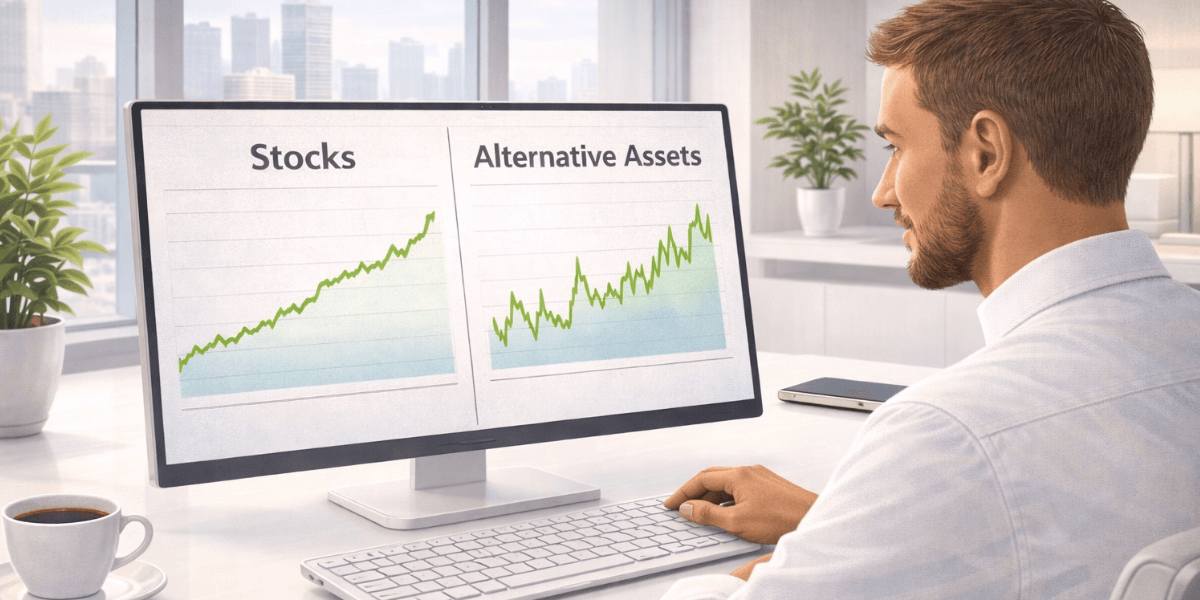
A senior-level analysis comparing stocks and alternative assets from a conservative investing perspective, explaining capital durability, tr...

A senior-level analysis explaining why stocks are fundamentally easier to analyze than other assets, focusing on cash flows, accounting stru...

A senior-level risk analysis comparing stocks and speculative assets, explaining how permanent capital risk, time horizons, and recovery dyn...