Overview of the Bahrain Stock Exchange (Bahrain Bourse)
A comprehensive overview of the Bahrain Stock Exchange (Bahrain Bourse), analyzing its market structure, regulation, liquidity characteristi...
Patience is often described as a virtue in investing, but that framing is misleading. Patience is not a moral quality; it is a structural advantage that certain assets provide and others do not. Stocks reward patience not because investors are disciplined, calm, or emotionally resilient, but because the economic mechanisms embedded in equity ownership transform time into value. Other assets do not do this in the same way. Some tolerate time. Some decay under time. Very few actively benefit from it.
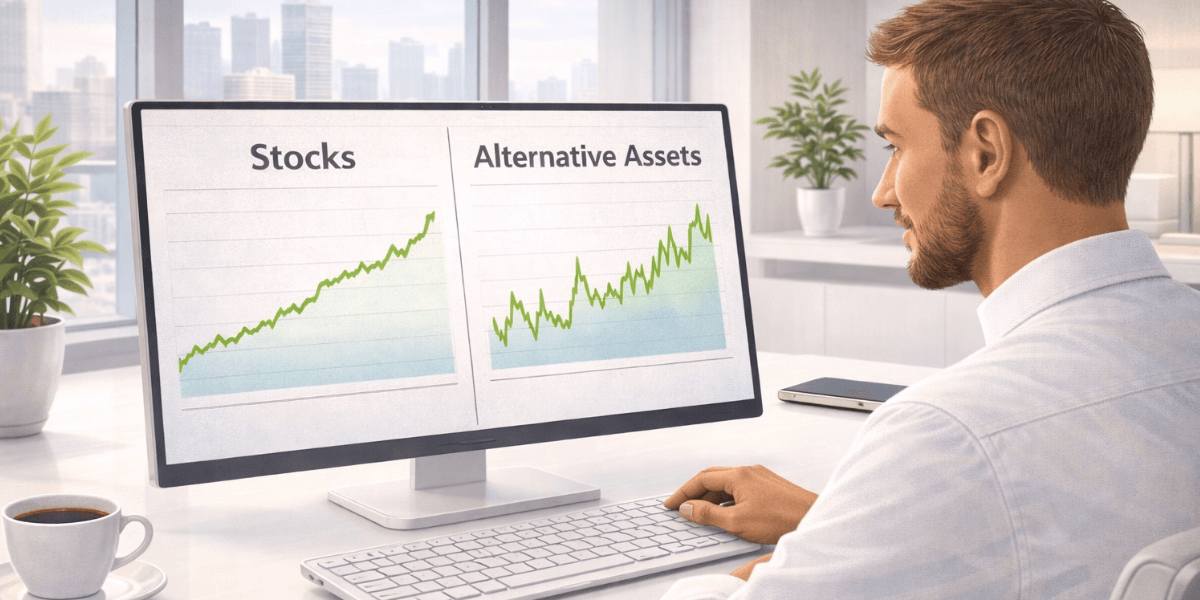
The persistent mistake investors make is to treat all assets as if time affects them equally. Charts reinforce this error. A stock, a commodity future, a currency pair, and a short-term trading instrument can all be plotted on the same axis, quoted to the same decimals, and traded through the same interface. This visual equality creates conceptual confusion. Investors assume that if assets move on the same screen, they must behave similarly over time. They do not.
For GCC investors, this misunderstanding is particularly costly. Many portfolios are globally exposed, sensitive to external liquidity cycles, and influenced by energy markets and US monetary policy. In such an environment, the difference between assets that absorb volatility through time and assets that amplify volatility through time becomes decisive. Stocks, when treated as long-duration claims on productive capital, sit on the favorable side of that divide.
This article explains why stocks reward patience more than other assets from a structural perspective. Not as an inspirational slogan, but as an economic reality. The objective is to show how time interacts differently with equities, why compounding dominates short-term noise, and why patient ownership is not a behavioral trick but a feature of the asset itself. For serious GCC investors, understanding this distinction is foundational to building portfolios that survive and grow across regimes.
The defining feature of stocks is that they represent ownership in productive enterprises. A stock is a claim on future cash flows generated by real economic activity. This activity continues regardless of daily market sentiment. Factories operate, software is sold, services are delivered, and profits are reinvested. Time does not merely pass for a stock; it allows the underlying business to operate.
This is the first reason patience is rewarded. As time passes, companies generate earnings. Those earnings can be reinvested to grow future earnings, distributed as dividends, or used to strengthen competitive positioning. Each of these actions compounds value. The investor does not need to act for this process to occur. Ownership alone is sufficient.
Other assets do not share this property. A commodity does not produce more commodities by being held. A currency does not generate additional currency through ownership. A derivative position does not create cash flows unless the price moves favorably. Time, in these cases, is neutral at best and corrosive at worst.
For GCC investors, whose portfolios often aim to preserve and grow capital across long horizons, this distinction matters. Equity ownership embeds a productive engine that works continuously. Patience allows that engine to operate. Impatience interrupts it.
Compounding is frequently described as a mathematical effect, but it is fundamentally an economic one. Compounding requires something that grows and then reinvests that growth. Stocks provide this internally through retained earnings and reinvestment.
When a company earns profits and reinvests them at acceptable returns, the base from which future profits are generated expands. This creates a self-reinforcing loop. Over long periods, this loop dominates price behavior. Short-term volatility becomes a rounding error relative to accumulated economic output.
Assets without internal compounding mechanisms rely on external forces for growth. Their value increases only if someone else is willing to pay more later. This does not mean they cannot generate returns. It means those returns are dependent on timing, sentiment, and liquidity rather than on an internal engine.
GCC investors often operate in environments where external forces are volatile: energy cycles, capital flows, and global risk sentiment can shift abruptly. Assets dependent on these forces require constant adjustment. Stocks, by contrast, allow the investor to step back and let internal compounding do the work, provided the underlying business remains viable.
One of the most counterintuitive aspects of stocks is that time reduces certain types of risk. Short-term price volatility can be high, but the probability of permanent loss declines as the holding period extends, assuming the business survives and adapts.
This happens because earnings accumulate and valuation errors correct. A company that continues to generate cash flows eventually justifies its existence regardless of short-term market pessimism. Time allows fundamentals to overwhelm noise.
For many other assets, time has the opposite effect. Risk accumulates. Leverage costs accrue. Roll costs eat into returns. Competitive dynamics or technological changes erode relevance. The longer the position is held, the more opportunities arise for adverse events to occur.
For GCC investors, who must navigate geopolitical risk, policy shifts, and global liquidity cycles, this asymmetry is critical. Stocks allow risk to be absorbed by time. Other assets often require risk to be actively managed against time. The former rewards patience. The latter punishes it.
Dividends are often discussed as income, but their deeper significance is anchoring. They tie returns to realized cash flows rather than to price appreciation alone. This anchoring stabilizes the relationship between ownership and outcome.
Reinvested dividends accelerate compounding. Each distribution increases the investor’s claim on future earnings, even if market prices fluctuate. Over long periods, reinvestment can account for a substantial portion of total return.
Assets without cash distributions rely entirely on price appreciation. This makes returns more sensitive to market psychology and liquidity conditions. The investor must be right about timing to realize gains.
For GCC investors seeking durable outcomes rather than tactical wins, dividends create a tangible connection between patience and reward. They provide feedback without requiring exit.
Stocks reward patience not only economically but behaviorally. Long holding periods reduce the frequency of decisions. Fewer decisions reduce the probability of error.
Short-term assets demand constant attention. Every price move invites action. Every period introduces new risk. Decision fatigue accumulates, and discipline erodes.
Long-term stock ownership allows investors to shift focus from price to process. Instead of reacting to market noise, the investor evaluates business performance, competitive positioning, and strategic direction. This shift aligns behavior with value creation.
For GCC investors managing complex lives, businesses, or family capital, reducing decision load is not a luxury. It is a structural advantage. Stocks offer that advantage when treated as long-term assets.
Liquidity is often framed as an unqualified benefit. In reality, liquidity is a double-edged sword. It enables flexibility, but it also tempts overreaction.
Stocks are highly liquid, but when held patiently, that liquidity functions as optionality rather than obligation. The investor can exit if needed, but does not need to.
In short-term trading assets, liquidity is constantly activated. The ease of entry and exit encourages frequent action, amplifying costs and errors.
For GCC investors with access to deep global equity markets, patience turns liquidity into insurance rather than temptation. This inversion is one of the quiet advantages of stock ownership.
Institutional capital dominates global equity markets. Pension funds, sovereign entities, and long-term allocators operate on multi-decade horizons. Stocks are designed to accommodate this scale and duration.
Other assets often exist primarily for hedging, speculation, or short-term exposure. Their structure reflects that purpose.
GCC investors, particularly those managing family or generational capital, are closer to institutional horizons than they often realize. Stocks align naturally with these objectives.
Patience is rewarded because the asset class is built for it.
Over long periods, global economic growth translates into higher corporate earnings. Productivity improvements, population growth, and innovation feed into equity returns.
Stocks capture this growth directly. Other assets capture it indirectly or not at all.
For GCC investors participating in global markets, equities provide a direct claim on worldwide economic expansion, regardless of local cycles.
Patience allows this macro tailwind to express itself fully.
Stocks reward patience not because investors are virtuous, but because the asset class is structurally designed to convert time into value. Ownership of productive enterprises embeds internal growth, compounding, and cash generation that operate continuously, regardless of short-term price movement.
Other assets can generate returns, sometimes spectacular ones, but they do so through mechanisms that demand timing, precision, and constant management. Time is neutral or hostile to those strategies. For stocks, time is an ally.
For GCC investors navigating global markets, external liquidity cycles, and structural volatility, this distinction is not academic. It determines whether portfolios are built to endure or to react.
Patience in stock investing is not passive. It is a deliberate alignment with an asset class whose economics favor long horizons. Investors who understand this stop fighting time and start using it. That shift, more than any tactical insight, is why stocks have rewarded patience across generations.
Not automatically. Patience is rewarded when stocks represent viable businesses that can generate and reinvest earnings over time.
Because they lack internal growth mechanisms and rely on price movement rather than ongoing economic output.
Volatility affects short-term prices, not long-term value creation. Time allows fundamentals to dominate price noise.
Because GCC investors often have long horizons and global exposure, making assets that absorb risk through time more suitable than those that concentrate it.
Disclaimer: This content is for education only and is not investment advice.

A comprehensive overview of the Bahrain Stock Exchange (Bahrain Bourse), analyzing its market structure, regulation, liquidity characteristi...

An in-depth analysis of the Kuwait Stock Exchange (Boursa Kuwait), explaining its structure, regulation, market behavior, and strategic rele...

A senior-level analysis explaining when stocks make more sense than diversified asset trading, focusing on correlation risk, time horizons, ...
A senior-level analysis comparing stocks and alternative assets from a conservative investing perspective, explaining capital durability, tr...

A senior-level analysis explaining why stocks are fundamentally easier to analyze than other assets, focusing on cash flows, accounting stru...

A senior-level risk analysis comparing stocks and speculative assets, explaining how permanent capital risk, time horizons, and recovery dyn...